
How Good KRA/KPI Systems Quietly Boost Productivity

Everyone looks busy. Standups are happening. Tasks are being tracked. And yet, the numbers are not moving.
I have seen this pattern more times than I can count. The founder is frustrated. The team is exhausted. And the performance system – the very thing meant to create clarity – is making things worse.
This article is not a theory. It is drawn from two real stories: one I lived personally, and one I heard from a founder we were working with. Both taught me the same lesson, just from different angles.
| Most KRA/KPI systems do not fail because the concept is wrong. They fail because the system was never built for that specific team, role, or reality. |
What This Covers
- What KRA and KPI actually mean – in one line each
- In my view: why most KRA/KPI systems fail
- A personal story: what happened when we cut 10 KPIs down to 3
- A founder conversation: why generic frameworks do not work
- What to do – and what to avoid
What KRA and KPI Actually Mean
Before anything else, let’s clear this up simply.
KRA (Key Result Area): What someone owns. The area they are responsible for.
KPI (Key Performance Indicator): How success in that area is measured.
For a sales person, for example:
- KRA → Generate business for the company
- KPI → Number of demos, conversion rate, revenue closed
That’s it. The concept is not complicated. What gets complicated is how companies implement it – and that is exactly where things go wrong.
In My View: Why Most KRA/KPI Systems Fail
I want to be direct here because I think this point gets avoided in most articles.
Most KRA/KPI systems fail not because founders do not care, but because the system was copied from somewhere else and dropped into a context it was never designed for.
A conversation I had with a founder:
I was once speaking with a founder about improving his team’s productivity. I suggested building a proper KRA/KPI structure. His response stopped me mid-sentence:
| “We tried KRA before. It didn’t work. It needed too many assumptions. It felt disconnected from what the team was actually doing.” |
I understood exactly what he meant. When I asked what their previous KRA looked like, it was a framework pulled from the internet – built for a different kind of company, a different sales motion, a different scale.
The KPIs on paper looked fine. On the ground, they were measuring things nobody cared about. Managers were chasing daily updates. Employees were filling in numbers. Nobody felt accountable to the outcome.
The core problem, in my view:
- A KPI that works for one company’s sales team can completely fail for another’s
- A framework that fits a SaaS startup will not fit a consulting firm
- A developer KPI in a 10-person company is not the same as one in a 200-person company
| KRA and KPI should not be generic. They need to align with the company’s vision, the specific job role, and realistic expectations – not a template someone found online. |
My Personal Story: What Happened When We Cut 10 KPIs to 3
This one comes from my own experience – something I observed and lived through directly.
At one point, our team was running a KRA/KPI system that, on paper, looked thorough. In reality, it was slowing everything down.
Here is what the system looked like:
- 7 to 10 KPIs per person
- Metrics like LinkedIn connection requests, first messages sent, emails dispatched, daily activity counts
- A tracker that needed to be updated constantly
- Weekly reviews of inputs, not outcomes
The system was not working well. People were spending real time maintaining the tracker instead of doing the work. The focus had drifted from results to reporting. I could see it – busyness without direction.
Then we made a change.
The following month, we stripped everything back to just three KPIs:
1. Demo count
2. Demo quality
3. Revenue closed
The result:
- Performance effectively doubled
- Meetings booked went up significantly
- The team moved from zero revenue closed to two major clients in the same period
| We stopped tracking effort and started tracking outcomes. Nobody asked how many emails were sent. They asked: did the demo happen, was it quality, did revenue follow? |
The team did not change. The targets did not get easier. What changed was clarity. Everyone knew exactly what mattered. And that was enough.
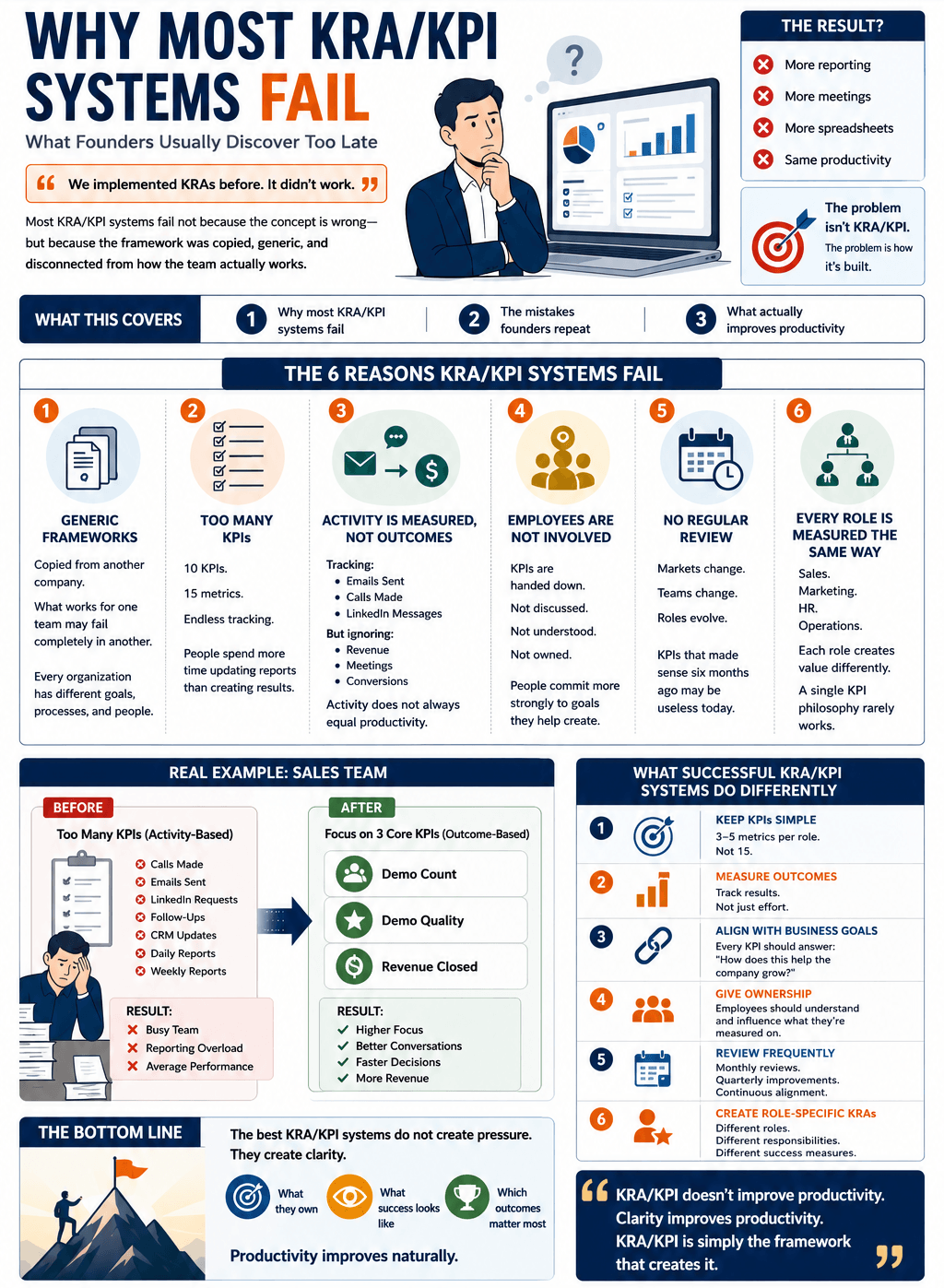
So What Does This Tell Us?
Both stories – my manager’s experience and the founder conversation – point to the same pattern.
- Too many KPIs create noise, not focus
- Measuring activity instead of outcomes rewards busyness, not results
- A generic framework feels like paperwork, not ownership
- When people are unclear on what success looks like, they default to appearing busy
The fix is not a better template. It is a better process for building the system in the first place.
What to Do – and What to Avoid
What Works
1. Keep it to 3–5 KPIs per role
If everything is a priority, nothing is. Fewer, sharper KPIs create more focus than exhaustive lists.
2. Measure outcomes, not activity
Demos booked beats emails sent. Revenue closed beats calls made. Ask whether each KPI reflects a result or just effort.
3. Build it around the specific role and company
Do not copy from another company or pull from a template. Ask: what does success in this role actually look like here, in this team, at this stage?
4. Align with company goals
Every KPI should connect to a business objective. If you cannot draw a straight line from the KPI to a company outcome, remove it.
5. Involve the employee
Targets that are imposed feel like micromanagement. Targets built with the employee feel like ownership. That difference shows up in results.
6. Review monthly
Business conditions change. Role expectations evolve. A KPI that is not revisited becomes irrelevant. Build a monthly review in from the start.
What to Avoid
- Copying a KRA framework from another company or the internet
- Tracking inputs (emails, messages, activity) instead of outputs (meetings, revenue, delivery)
- Building 10+ KPIs because it feels more thorough – it is not
- Setting KPIs once and never revisiting them
- Making assumptions without involving the employee in building the targets
- Using the same KPI structure for every role, every team, every function
The Bottom Line
I have seen both sides of this. A bloated KPI system that buried a team in reporting. A founder who had tried KRA before and walked away frustrated. In both cases, the problem was not the concept.
The problem was that the system was never designed for the specific reality it was dropped into.
KRA/KPI does not improve productivity
When your team knows exactly what they own, how success is defined, and what outcomes actually matter – performance follows. The system is just the structure that makes that clarity possible.
Build it right, and it works quietly in the background. Build it wrong, and it becomes the reason your best people are always busy but never moving forward.
Want to build a KRA/KPI system that actually fits your team? Emgage works with founders to design performance frameworks aligned to their company goals, role realities, and culture. Talk to us.
