
The Complete Guide to the POSH Act: Why It Matters, How It Works, and Industry Requirements

The Complete Guide to the POSH Act: Why It Matters, How It Works, and Industry Requirements
Many organizations view POSH compliance as a policy requirement or an annual reporting activity. In practice, it goes much further. The framework is designed to create safer workplaces, establish clear complaint mechanisms, support employees, and help organizations respond effectively when concerns arise.
For growing businesses, compliance is not only about preparing documents or constituting an Internal Committee. It is about building systems, awareness, and accountability before issues develop.
This handbook has been prepared to simplify the POSH framework for employers, founders, HR professionals, and operational leaders. Instead of complex legal language, it explains the practical requirements under the law, how implementation works, and where different industries may require additional safeguards.
Through this guide, the POSH requirements have been broken down into practical steps so organizations can stay compliant while building safer and more responsible workplaces.
What This Guide Covers
- Why the POSH Act was introduced and the legal gap it addressed
- What constitutes workplace sexual harassment under the law
- Who and what the law protects
- How to build a POSH framework
- Industry-specific requirements for offices, retail establishments, and factories
- Reporting timelines and annual filings
- Penalties and consequences for non-compliance
Why Was the POSH Act Introduced
Before 2013, India did not have a dedicated law dealing specifically with workplace sexual harassment. Organizations often lacked formal complaint mechanisms, and employees had limited protection when workplace misconduct occurred.
The major shift came through the Vishakha vs. State of Rajasthan judgment in 1997, where the Supreme Court introduced the Vishakha Guidelines and placed responsibility on employers to maintain safe workplaces. (Source: Vishakha Guidelines, Supreme Court of India, 1997)
The POSH Act introduced in 2013 converted these guidelines into law and established a structured compliance framework for organizations. (As per the Sexual Harassment of Women at Workplace (Prevention, Prohibition and Redressal) Act, 2013)
The framework also supports constitutional protections relating to equality, dignity, and safe working conditions. (Source: Constitution of India – Articles 14, 15, 19(1)(g), and 21)
Beyond legal compliance, safer workplaces improve workforce participation, employee confidence, and long-term organizational growth.
Understand What Counts as Workplace Sexual Harassment
When discussing POSH with businesses, one misconception appears repeatedly: MANY ASSUME WORKPLACE HARASSMENT REFERS ONLY TO PHYSICAL MISCONDUCT.
The law is wider.
The POSH framework covers both direct acts and workplace environments that create intimidation, discomfort, hostility, or unequal treatment. (As per Section 2(n), Sexual Harassment of Women at Workplace Act, 2013)
This may include:
- Unwelcome physical contact
- Requests for sexual favours
- Sexually coloured remarks or jokes
- Sharing explicit material
- Repeated inappropriate messages
- Verbal, non-verbal, or physical conduct of a sexual nature (Source: Section 2(n), POSH Act, 2013)
Organizations should remember that intent alone may not determine harassment. The impact on the employee and workplace environment is equally important.
Know Who and What the Law Covers
Many businesses assume POSH applies only to permanent employees working from office premises.
The actual coverage is much broader.
Protection extends to:
| Permanent employees | Probationers |
| Interns and trainees | Contract workers |
| Daily wage staff | Consultants |
| Temporary employees | Women entering business premises including clients, vendors, service providers, and visitors |
(Source: Section 2(f), POSH Act, 2013)
The workplace definition also extends beyond office walls and may include:
- Office premises and branches
- Company transport facilities
- Business travel locations
- Client sites
- Work-from-home arrangements
- Digital platforms including email, Zoom, WhatsApp, Slack, Teams, and official communication systems.
(Source: Section 2(o), POSH Act, 2013; Ministry of Women and Child Development, SHe-Box Portal, 2025)
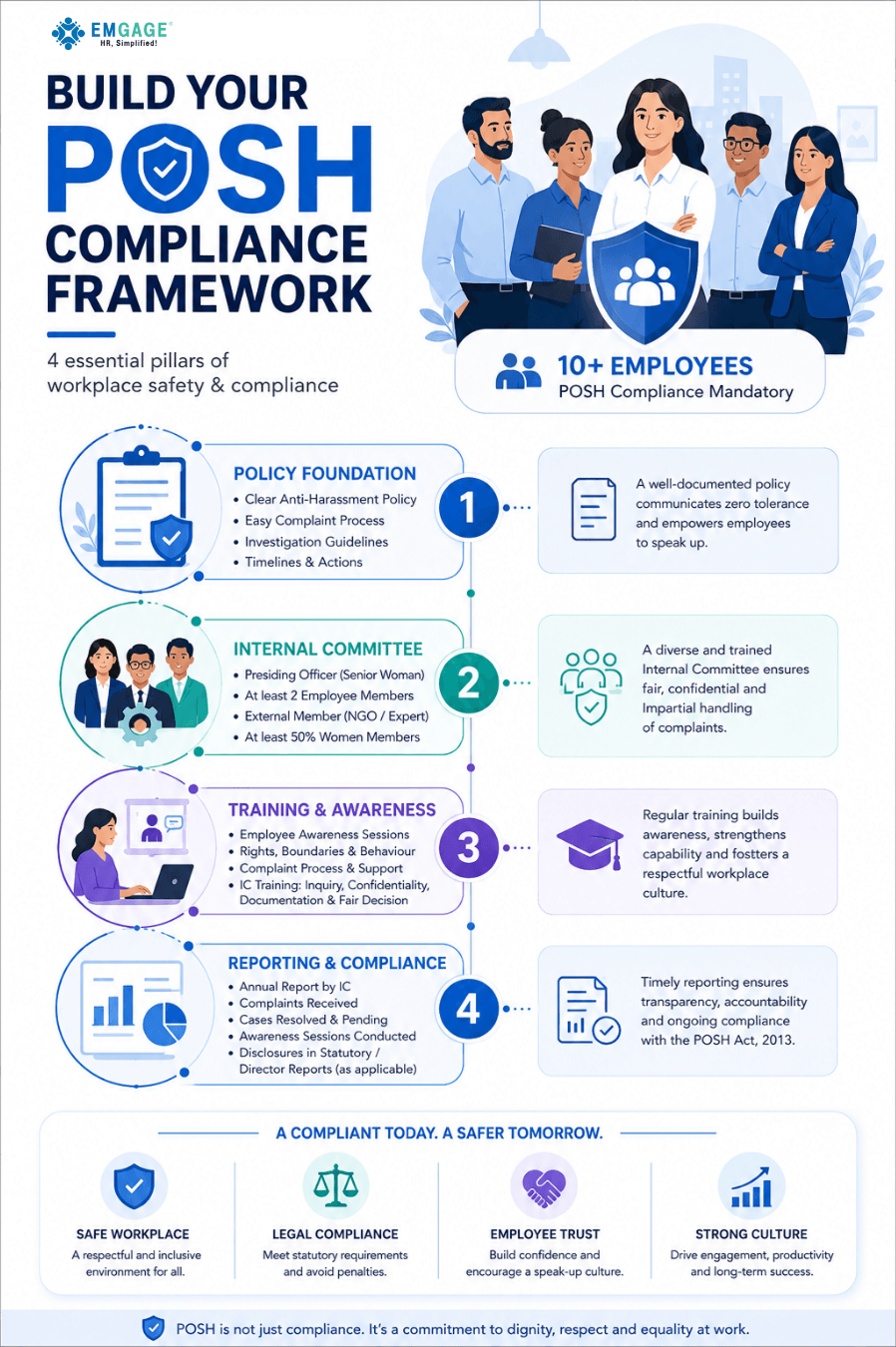
Build Your POSH Framework
Once an organization has 10 or more employees, following POSH compliance becomes mandatory under the POSH Act, 2013.
A simple implementation process is:
Create Policy → Form Internal Committee → Conduct Training → Submit Reports
1. Create a POSH Policy
Every organization should have a written policy against sexual harassment at the workplace.
The policy should clearly explain:
- What workplace harassment means
- How employees can raise complaints
- Complaint timelines and process
- Investigation procedure
- Actions taken against misconduct
The policy should be easily available to employees through onboarding documents, employee handbooks, emails, notice boards, and local language communication wherever required.
2. Form an Internal Committee (IC)
Organizations with 10 or more employees must form an Internal Committee to handle complaints and investigations.
The committee generally includes:
- Presiding Officer: Senior woman employee
- Employee Members: At least two employees aware of employee welfare, legal matters, or social work
- External Member: NGO representative, consultant, or legal expert
At least 50% of the committee members must be women.
3. Conduct Training & Awareness Sessions
Having a policy alone is not enough. Employees should regularly receive POSH awareness training covering:
- Workplace behaviour and boundaries
- Reporting process
- Employee rights under POSH
- Complaint procedures
- Respectful workplace conduct
IC members should also be trained on:
- Inquiry handling
- Maintaining confidentiality
- Documentation and evidence handling
- Fair and unbiased decision-making
Regular refresher sessions are recommended.
4. Annual Reporting & Compliance
The Internal Committee should prepare annual reports covering:
- Complaints received
- Cases resolved
- Pending cases
- Awareness sessions conducted
Companies may also include POSH-related disclosures in their statutory and Director reports as applicable.
Annual POSH Reporting Note:
The POSH Annual Report follows the calendar year cycle (January–December) and must generally be submitted by 31 January of the following year.
Therefore, for FY 2026–27, the relevant annual POSH report would be due on 31 January 2027. (Source: Rule 14, POSH Rules, 2013)
Follow the Complaint Timeline
POSH investigations operate through prescribed timelines.
Complaint submission generally happens within 3 months from the incident. (Source: Section 9, POSH Act, 2013)
Conciliation may be initiated only at the request of the complainant, and monetary settlements are not permitted. (Source: Section 10, POSH Act, 2013)
Internal Committee investigations should generally conclude within 90 days. (Source: Sections 11 and 13, POSH Act, 2013)
Recommendations should be issued within 10 days after completion of inquiry. (Source: Section 13, POSH Act, 2013)
Employers should implement recommendations within 60 days. (Source: Section 13(4), POSH Act, 2013)
Apply Industry-Specific POSH Requirements
POSH obligations remain the same across industries, but workplace risks differ.
A retail outlet dealing with customers every day faces different challenges compared to a manufacturing facility operating multiple shifts.
Similarly, technology companies managing remote teams encounter risks that may not appear inside factories.
| The Core Focus | Corporate Offices, Tech Firms, Retail Businesses | Factories & Industrial Plants |
| Typical Setting | Corporate offices, technology hubs, retail outlets, hybrid workplaces | Production units, warehouses, fabrication floors |
| Major Risk Areas | Client visits, vendor interactions, customer-facing operations, late-night transport, remote work tools | Night shifts, isolated locations, warehouses, machinery zones |
| Committee Strategy | Branch-wise committees where applicable | Plant-wise committees |
| Government Filing | Labour authorities | Factory authorities |
Corporate environments should pay particular attention to third-party harassment, customer interactions, transport safety, and remote work systems.
Factories may require stronger controls around communication accessibility, regional language awareness, isolated zones, lighting, CCTV review, and night-shift support systems.
Small Organizations and Startups
Organizations employing fewer than 10 employees are not required to establish an Internal Committee.
However, POSH obligations continue to apply.
Complaints may be referred to the Local Committee (LC) established by the District Officer. (Source: Section 6, POSH Act, 2013)
Small businesses should still maintain:
- Written POSH policy
- Awareness programs
- Complaint procedures
- Local Committee contact details
Non-Compliance Consequences
Failure to establish an Internal Committee, investigate complaints properly, or comply with reporting requirements may attract penalties up to ₹50,000. (Source: Section 26, POSH Act, 2013)
Repeated violations may lead to increased penalties and may affect renewal, continuation, or approval of business licences. (Source: Section 26, POSH Act, 2013)
| Closing Note
I hope this handbook gives you a practical understanding of how POSH compliance works across different industries and business stages. Building compliance systems early is not only about avoiding penalties. It helps organizations create safer workplaces, strengthen employee trust, reduce risk, and support long-term growth. |
| Sources Referenced
• Sexual Harassment of Women at Workplace (Prevention, Prohibition and Redressal) Act, 2013 • Sexual Harassment of Women at Workplace (Prevention, Prohibition and Redressal) Rules, 2013 • SHe-Box – Ministry of Women and Child Development • Constitution of India • Vishakha vs. State of Rajasthan (1997) Judgment |
This handbook is intended for general guidance and awareness only and should not be treated as legal advice. Organizations should refer to official notifications and professional guidance for final applicability and interpretation.
