
5 Reasons Why You Need To Outsource Your HR

Most founders don’t wake up one morning and decide to outsource HR.
Usually, the decision comes after another payroll mistake. Another employee complaint. Another compliance concern. Another HR manager resigning.
At first, HR feels manageable. One person handles it. Things get done. Then the company grows. And suddenly HR becomes a full-time responsibility that nobody is fully owning.
By the time most founders ask “Should we outsource HR?”, the signs were already there for months. The better question to ask now is: has the business grown faster than the HR structure supporting it?
| This is not a checklist for companies in crisis. It is a pattern that shows up in growing businesses everywhere. If any of these signs sound familiar, you are not alone. And you are not too late to act. |
What This Covers
- The 5 signs that HR is taking more than it is giving
- Common problems founders overlook until they become expensive
- When internal HR starts becoming a bottleneck
- How to know when it is time to rethink your HR structure
The 5 Signs Your HR Has Stopped Working For You
1. You are spending more time on HR than on growth
Every founder should stay connected to their people. But founders should not spend hours every week approving leave, answering HR queries, solving payroll issues, or chasing documents. If HR is taking a significant chunk of your week, growth is losing your attention.
Reality check: if employees come to you first with HR questions, you are already acting as HR.
You started a business to build it. Not to approve leave requests. When founder time is being consumed by HR operations, the business is losing its most important resource to its most manageable problem.
2. Payroll errors are becoming normal
A payroll mistake once is understandable. Every month is not. Wrong salary calculations, incorrect leave deductions, reimbursement delays, PF or ESIC issues — these are not minor admin problems. Payroll is one of the fastest ways to lose employee trust.
Employees may forgive one mistake. They rarely forgive repeated ones. And by the time they stop raising the issue, they have usually already started looking elsewhere.
The damage from payroll errors is not just financial. It is the signal it sends: that the company cannot get the basics right.
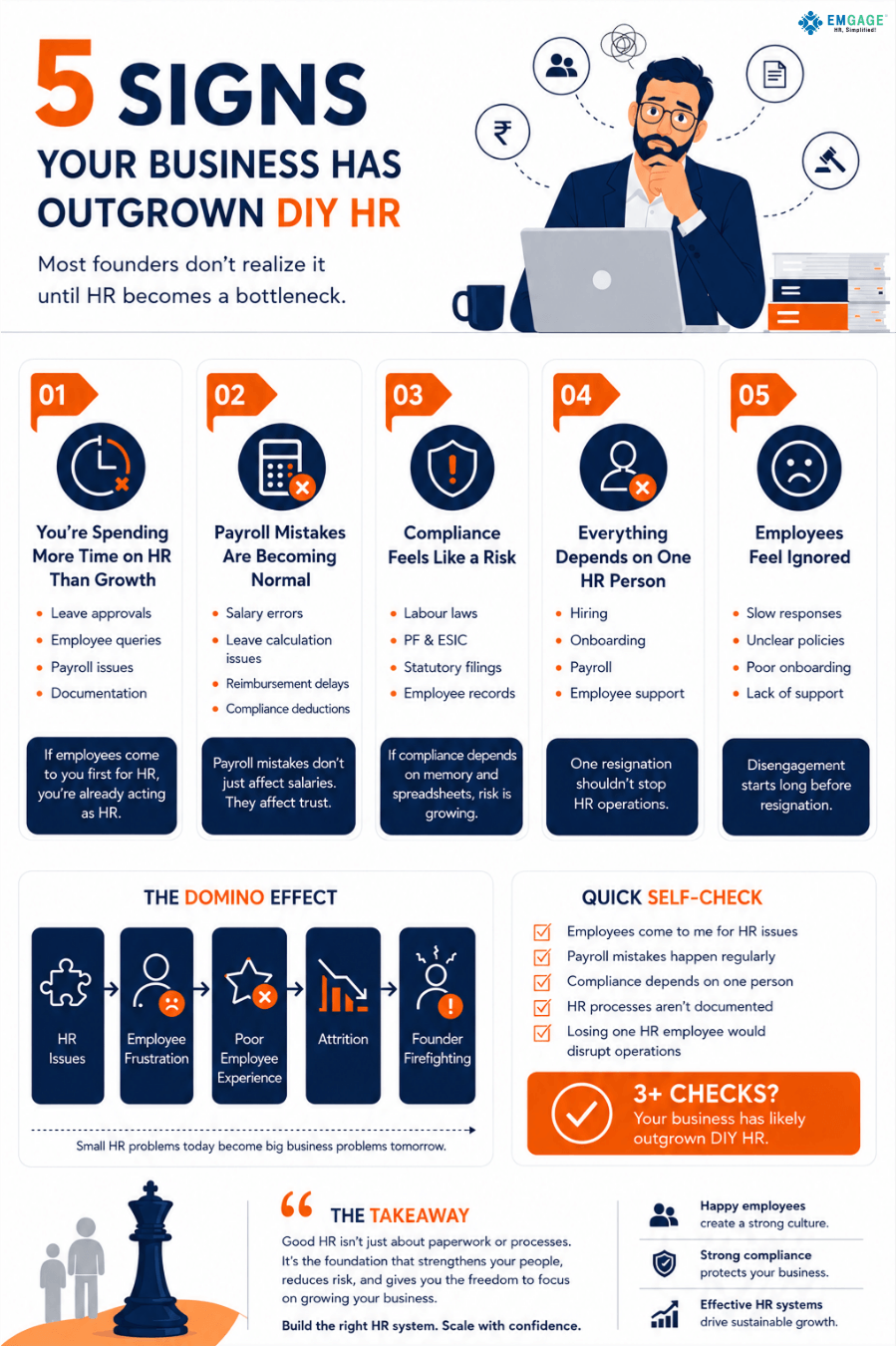
3. Compliance is starting to feel like a risk
Most businesses do not notice compliance when everything is working. They notice it when something goes wrong. As teams grow, so do the obligations: PF, ESIC, statutory records, labour law updates, employee documentation. If compliance depends on one person’s memory or manual tracking, the risk grows every month.
The problem is not that founders are careless. The problem is that compliance at scale requires systems, not just awareness. One missed filing or an outdated document can become a much larger issue than the effort it would have taken to stay current.
Here is something most founders do not fully appreciate: compliance is not something HR or the founder can fully own on their own. It requires a dedicated compliance and legal expert — someone who tracks regulatory updates, prepares for audits, and ensures filings are accurate and on time. A government audit does not warn you. It arrives. And when it does, gaps in your compliance record can leave you with a penalty that costs far more than the structured support that would have prevented it.
If your compliance process depends on someone remembering, it is already a risk. And if an audit ever arrives unannounced, that risk has a price tag.
4. Everything depends on one HR person
This is one of the most common situations in growing companies. One HR executive handles hiring, onboarding, payroll, attendance system, employee concerns, and compliance. Everything works – until that person leaves.
Then processes stop. Information gets lost. Employees wait for support. And the founder suddenly realises that what looked like a functioning HR department was actually one person carrying everything alone.
Ask yourself: what happens if your HR person resigns tomorrow? Who knows the processes? Who handles the next payroll cycle? Who onboards the new joiner starting Monday? If the honest answer is “nobody else,” that is a structural problem, not a people problem. Replacing HR employees repeatedly is also expensive — recruitment cost, training cost, lost institutional knowledge, and broken continuity every time someone walks out.
As the saying goes: never put all your eggs in one basket. Running your entire HR function through a single person is exactly that. When that basket tips, everything in it breaks at once.
A business should not be one resignation away from an HR crisis.
5. Employees are starting to feel ignored
This is usually the last warning sign — and the most costly. Employees stop getting timely responses to their queries. Policies are unclear or undocumented. New joiners are not properly onboarded. Nobody knows who to approach when something goes wrong.
Eventually they disengage. Then they leave. And when they leave, they do not say it was because of HR. They say it was a “better opportunity.” That is usually not the real reason.
The problem is rarely the employee. The problem is that the HR system could not support them when they needed it. And when your best people feel unsupported, they find somewhere that does.
Poor employee experience is not an HR problem. It is a retention problem.
The Bottom Line
Good HR is not just about payroll and policies. It creates structure. It supports employees. It protects compliance. And it allows founders to focus on growing the business instead of managing day-to-day HR operations.
None of the five signs above require a crisis to fix. They are patterns. And patterns, once you can see them, can be changed before they become expensive.
If HR is creating more firefighting than structure, it may be time to rethink how it is being managed.
