
9 Reasons Your Best Employees Leave (and How To Retain Them?)

It is appraisal season. And somewhere right now, a founder is reading a resignation letter they did not see coming.
The employee had been there for two years. Reliable. Sharp. The kind of person the team quietly depends on. And now they are leaving. The founder will spend the next week asking: why? They will get a polite answer about a ‘better opportunity.’ That is not the real answer.
The real answer was forming for months. You just were not looking in the right places.
| This document is not a theory. It is a pattern — one that shows up across dozens of companies. If any of these scenarios sound familiar, you are not alone. But you are also not too late to act. |
What This Covers
- Why talented employees — especially Gen-Z talent stop speaking up before they leave
- The 9 real reasons behind most resignations
- What founders can do differently before the next appraisal cycle
The 9 Reasons Your Best People Leave
1. The vibe is broken
Culture is not a policy document. It is what happens in the room when leadership is not watching. When nepotism decides who gets praised, when bad behaviour from a senior colleague goes unchecked, when a new employee is quietly told by a veteran, ‘this place is not worth it’ — the culture is broken. Talented people sense it fast. They leave faster.
2. The salary has not moved — but the market has
You hired them at a fair number. That was two years ago. They have grown. The market has grown. Your increment has not kept up. They are not leaving for greed. They are leaving because staying feels like a signal: we do not rate you enough to pay you for who you have become.
3. The workload is unmanageable — and unequal
Two people in the same role. One carries significantly more than the other. The harder-working one is rewarded with more work, not more pay, not more recognition. That equation does not hold for long. Add unrealistic targets on top, and burnout is not a risk. It is a schedule.
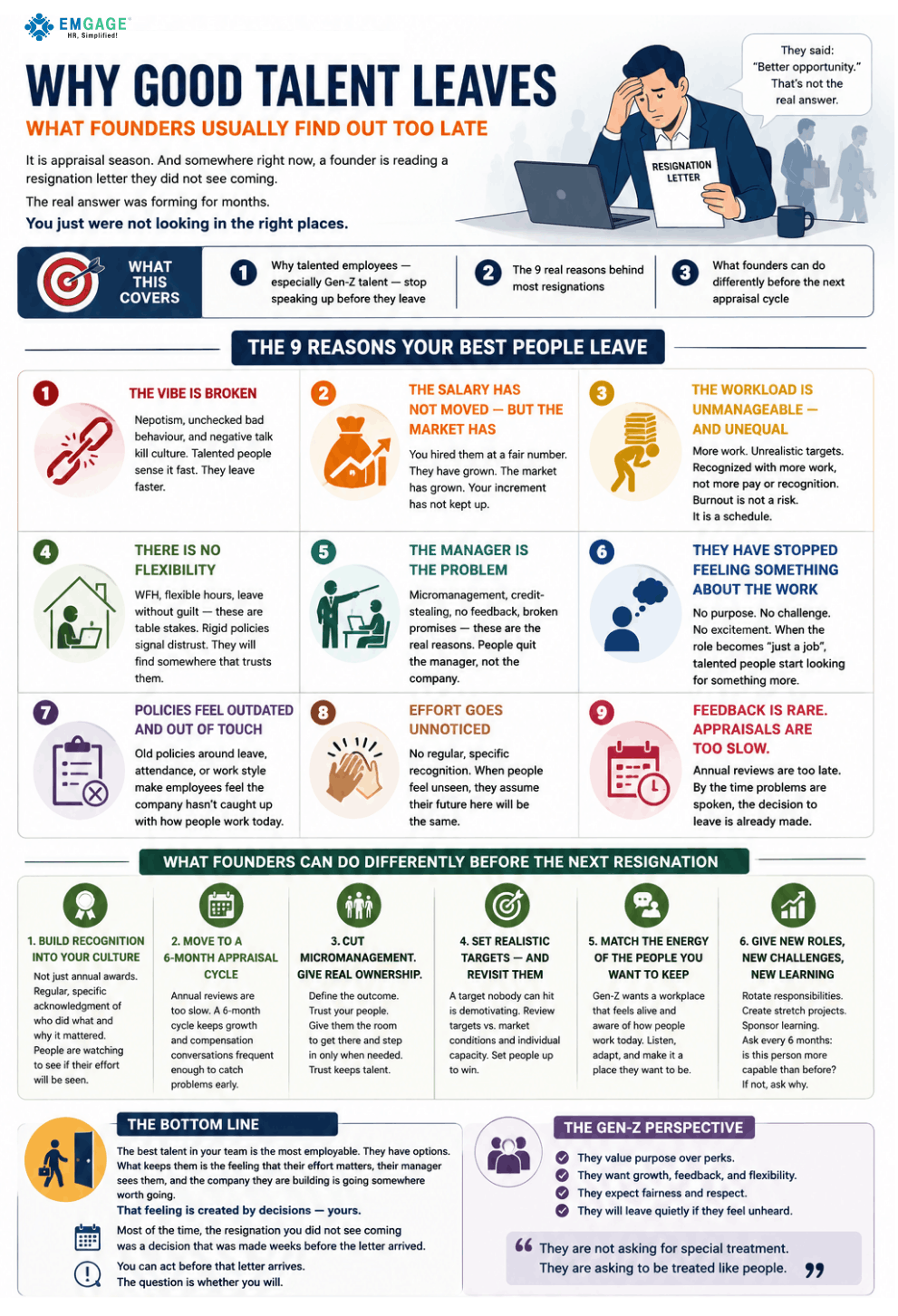
4. There is no flexibility
Work-from-home, flexible hours, leave without guilt — these are not perks anymore. They are table stakes. Rigid policies signal that the company does not trust its employees. And employees who feel they are not trusted will find somewhere that does.
5. The manager is the problem
Your best employee does not quit the company. They quit the person they report to every day. Micromanagement, credit-stealing, no feedback, broken promises — these do not show up in exit interviews. But they are almost always the reason. The manager you are keeping because they deliver numbers is losing you the people who generate those numbers.
6. They have stopped feeling something about the work
Talented people need to feel useful. Challenged. Like they are building something. When the role becomes routine — same tasks, same problems, no new ownership — they disengage quietly. They will not tell you they are bored. They will just accept the next offer that feels more interesting.
7. They cannot see where the company is going
Good talent wants to be part of something that is growing. If the company direction is unclear, if leadership promises are not kept, if the last three town halls were vague, they start to wonder whether they are building a career here or just filling time. Once they start wondering, they start looking.
8. Mental health and pressure are not being taken seriously
Gen-Z employees are the first to name burnout as a reason to leave — not a weakness to push through. When a company treats exhaustion as a performance issue instead of a management signal, it loses its most self-aware employees first. They are not fragile. They are informed. And they will not stay somewhere that ignores what they are telling you.
9. There is no proper policy, and they notice
When a company has no clear HR policies — no documented leave rules, no appraisal process, no grievance structure — talented people do not see a startup vibe. They see a red flag. Their thinking is straightforward: if this company cannot build a basic policy, how seriously is it running everything else? Policy is not paperwork. It is a signal of professionalism. Without it, your best people quietly question whether this is a place worth building a career in.
What to Do Before the Next Resignation Surprises You
Build policies that are clear — and flexible
You do not need a 40-page HR manual. You need documented answers to the questions employees ask most: how does leave work, how are decisions made, and what happens when something goes wrong. Write it down. Make it accessible. Flexible policies — ones that treat employees like adults — signal that you trust them.
Recognise and reward hard work — visibly
Effort that goes unnoticed is effort that eventually goes elsewhere. Build recognition into your culture — not just annual awards, but regular, specific acknowledgment of who did what and why it mattered. The people watching are deciding whether their own effort will be seen.
Move to a 6-month appraisal cycle
Annual reviews are too slow for the pace at which people work today. A 6-month cycle keeps compensation and growth conversations frequent enough to catch problems early — before someone has already decided to leave. It also signals that you are paying attention all year, not just in March.
Cut micromanagement. Give real ownership
Your best people do not need to be watched. They need to be trusted. Define the outcome clearly, give them the room to get there, and step in only when needed. Micromanagement tells a talented person that their judgment is not valued. They will go somewhere, it is.
Set realistic targets — and revisit them
A target nobody can hit is not motivating. It is demoralizing. Review whether your targets reflect market conditions and individual capacity. When people feel set up to fail, they stop trying — or they stop showing up entirely.
Match the energy of the people you want to keep
The Gen-Z workforce wants to work somewhere that feels alive — where the culture, the communication, and the environment reflect some level of awareness about how people actually work today. This does not mean changing who you are. It means being willing to listen, adapt, and make the workplace feel like somewhere they genuinely want to be.
Give new roles, new challenges, and new learning
Do not let talented people stagnate. Rotate responsibilities. Create stretch projects. Sponsor learning. When someone grows inside your company instead of leaving to grow elsewhere, everyone wins. The question to ask every six months: Is this person more capable than they were? If not, ask why.
The Bottom Line
The best talent in your team is the most employable. They have options. What keeps them is not a ping-pong table or a team outing. It is the feeling that their effort matters, their manager sees them, and the company they are building is going somewhere worth going.
That feeling is created by decisions — yours. Most of the time, the resignation you did not see coming was a decision that was made weeks before the letter arrived.
You can act before that letter arrives. The question is whether you will.
Want to understand what your team is actually feeling? Emgage helps founders build structured feedback loops and HR processes that surface problems before they become resignations. Talk to us.
