
9 Most-Common Payroll Errors (& How To Avoid Them in 2026)
Working with Emgage, I’ve had many conversations with HR professionals facing payroll-related issues – whether it’s incorrect overtime calculations, missed salary revisions, or inaccurate tax deductions.
What I’ve noticed is that the same payroll mistakes often occur across different organizations. In most cases, these aren’t major failures but small oversights that go unnoticed during a busy payroll cycle.
Based on these recurring patterns, I’ve put together a list of the most common payroll errors companies make and how they can avoid them.
1. Compliance Errors
Compliance errors occur when payroll processing does not follow government regulations related to Provident Fund (PF), Employee State Insurance (ESI), Professional Tax (PT), TDS, minimum wages, gratuity, or labor laws.
Common Causes
- Outdated statutory settings
- Incorrect employee eligibility mapping
- Changes in government regulations not updated in the system
- Manual calculations
Impact
- Government penalties
- Legal complications
- Failed audits
- Damage to company reputation
Prevention
- ✔ Regularly update compliance rules in HRMS
- ✔ Conduct compliance audits quarterly
- ✔ Use automated payroll software with statutory updates
- ✔ Train HR and payroll teams on regulatory changes
2. Salary Calculation Errors
These errors happen when salary components such as Basic Pay, HRA, Allowances, Incentives, Overtime, and Deductions are calculated incorrectly.
Common Causes
- Wrong salary structure setup
- Manual spreadsheet calculations
- Incorrect payroll formulas
- Missing attendance data
Impact
- Underpayment or overpayment
- Employee complaints
- Additional correction work
Prevention
- ✔ Automate payroll calculations
- ✔ Verify salary structures during employee onboarding
- ✔ Review payroll reports before final approval
- ✔ Implement maker-checker approval processes
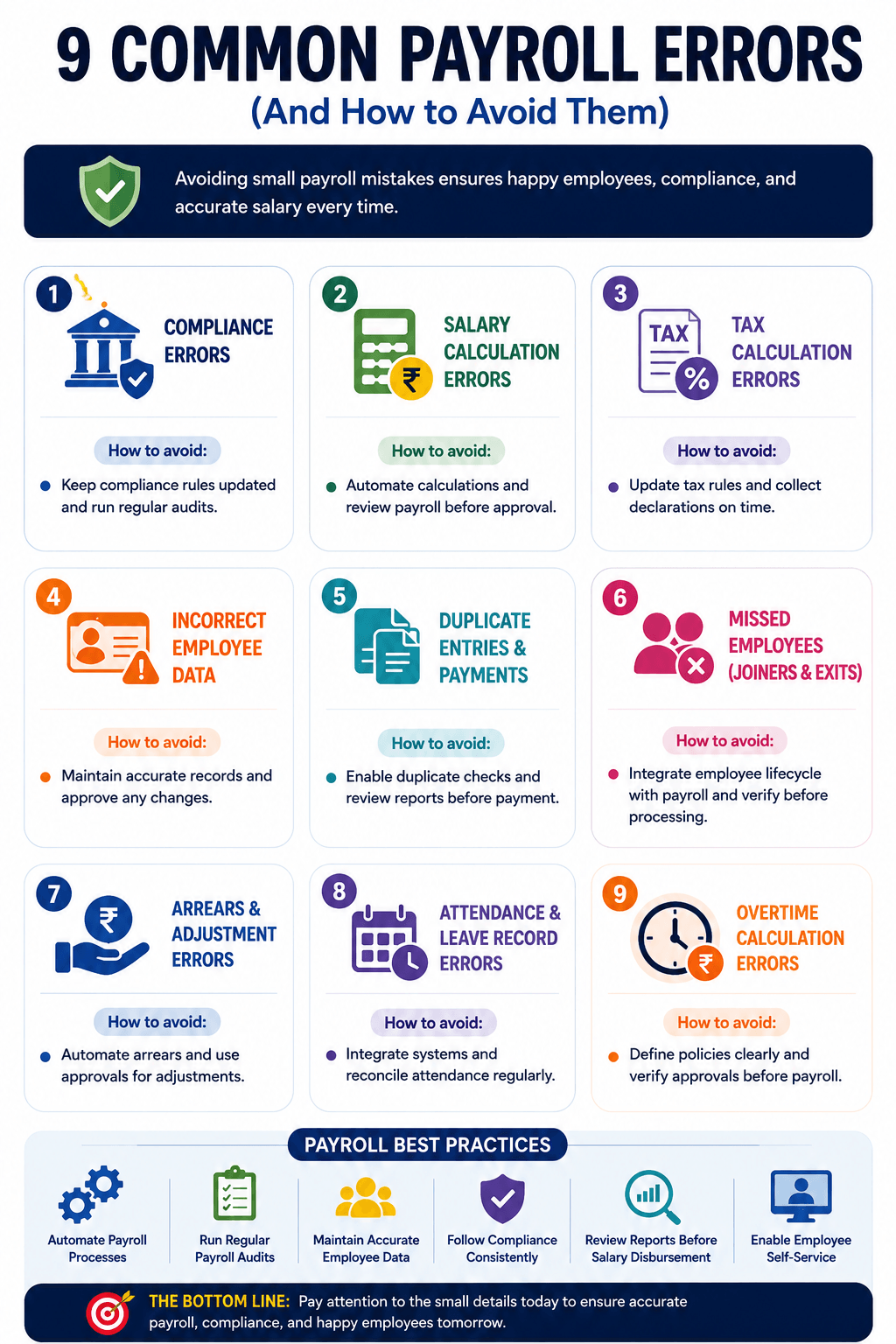
3. Tax Calculation Errors
Incorrect tax deductions due to outdated tax slabs, wrong declarations, or missing investment proofs.
Common Causes
- Employee declaration errors
- Un-updated tax rates
- Missing exemptions
- Incorrect tax regime selection
Impact
- Employee tax liabilities
- Compliance risks
- Additional tax recovery efforts
Prevention
- ✔ Update tax rules annually
- ✔ Collect declarations and proofs on time
- ✔ Allow employees to review tax projections
- ✔ Conduct periodic tax audits
4. Incorrect Employee Data
Payroll calculations based on inaccurate employee information such as salary, bank account details, department, designation, or joining date.
Common Causes
- Manual data entry mistakes
- Unapproved employee changes
- Incomplete onboarding
Impact
- Salary transfer failures
- Incorrect deductions
- Payroll reprocessing
Prevention
- ✔ Implement approval workflows for employee updates
- ✔ Perform regular employee data audits
- ✔ Restrict unauthorized data modifications
- ✔ Maintain centralized employee records
5. Duplicate Entries and Payments
The same employee or payroll transaction gets processed more than once, resulting in duplicate payments.
Common Causes
- Multiple payroll runs
- Duplicate employee records
- System synchronization issues
- Human error
Impact
- Financial losses
- Payroll reconciliation issues
- Time-consuming recovery process
Prevention
- ✔ Enable duplicate validation checks
- ✔ Use unique employee IDs
- ✔ Review payroll summary reports before disbursement
- ✔ Maintain proper audit trails
6. Missed Employees (New Joiners and Exits)
Employees who should receive salary are excluded, or employees who have exited continue receiving payments.
Common Causes
- Delayed onboarding updates
- Exit process not completed
- Payroll cutoff date issues
- Poor coordination between HR and Payroll teams
Impact
- Employee dissatisfaction
- Recovery challenges
- Payroll inaccuracies
Prevention
- ✔ Integrate employee lifecycle with payroll
- ✔ Establish payroll cut-off procedures
- ✔ Verify new joiners and exits before processing payroll
- ✔ Use automated employee status tracking
7. Arrears and Adjustment Errors
Errors in salary revisions, arrears calculations, bonuses, incentives, reimbursements, or recoveries.
Common Causes
- Delayed salary revisions
- Manual adjustment calculations
- Missing historical payroll records
Impact
- Incorrect employee compensation
- Payroll disputes
- Increased workload
Prevention
- ✔ Automate arrear calculations
- ✔ Maintain payroll history records
- ✔ Verify salary revisions before payroll processing
- ✔ Use approval workflows for adjustments
8. Attendance and Leave Record Errors
Payroll calculations mainly become inaccurate due to incorrect attendance records, leave balances, overtime entries, or loss of pay calculations.
Common Causes
- Missing punches
- Incorrect leave approvals
- Attendance device synchronization issues
- Manual attendance adjustments
Impact
- Incorrect salary processing
- Employee grievances
- Repeated payroll corrections
Prevention
- ✔ Integrate payroll modules, attendance and leave
- ✔ Regularly reconcile attendance data
- ✔ Configure attendance policies properly
- ✔ Allow employees to review attendance records before payroll closure
9. Overtime Calculation Errors
Incorrect overtime hours or overtime rates result in inaccurate salary payouts.
Common Causes
- Incorrect attendance or punch-in/punch-out records
- Overtime policy not properly configured in the payroll system
- Manual calculation mistakes
- Unapproved or unauthorized overtime entries
- Errors in overtime rate setup (weekday, weekend, or holiday rates)
- Lack of integration between attendance and payroll systems
Impact
- Overpayment or underpayment of employees
- Employee dissatisfaction and payroll disputes
- Increased payroll processing and correction efforts
- Reduced trust in payroll accuracy
- Compliance issues if labor laws regarding overtime are not followed
Prevention
- ✔ Define overtime policies clearly
- ✔ Use automated attendance integration
- ✔ Verify manager approvals before processing
- ✔ Regularly audit overtime records and calculations
- ✔ Ensure payroll and attendance systems are properly integrated
The more organizations I work with, the more I realize that payroll is a reflection of operational accuracy. Employees expect their salaries to be correct, and meeting that expectation consistently requires discipline, attention to detail, and the right systems.
Sometimes, avoiding payroll errors isn’t about doing more—it’s about checking the small things before they become big problems.
