
How HR Compliance Registration Works in India: Documents, Process and Employer Responsibilities (2026 Guide)
What Is HR Compliance Registration?
HR compliance registration in India involves obtaining the registrations and licences required for a business and its employees. These may include EPF, ESIC, Shops and Establishments, factory and contract labour registrations, depending on the business and applicable laws.[Source: Ministry of Labour and Employment, Government of India.]
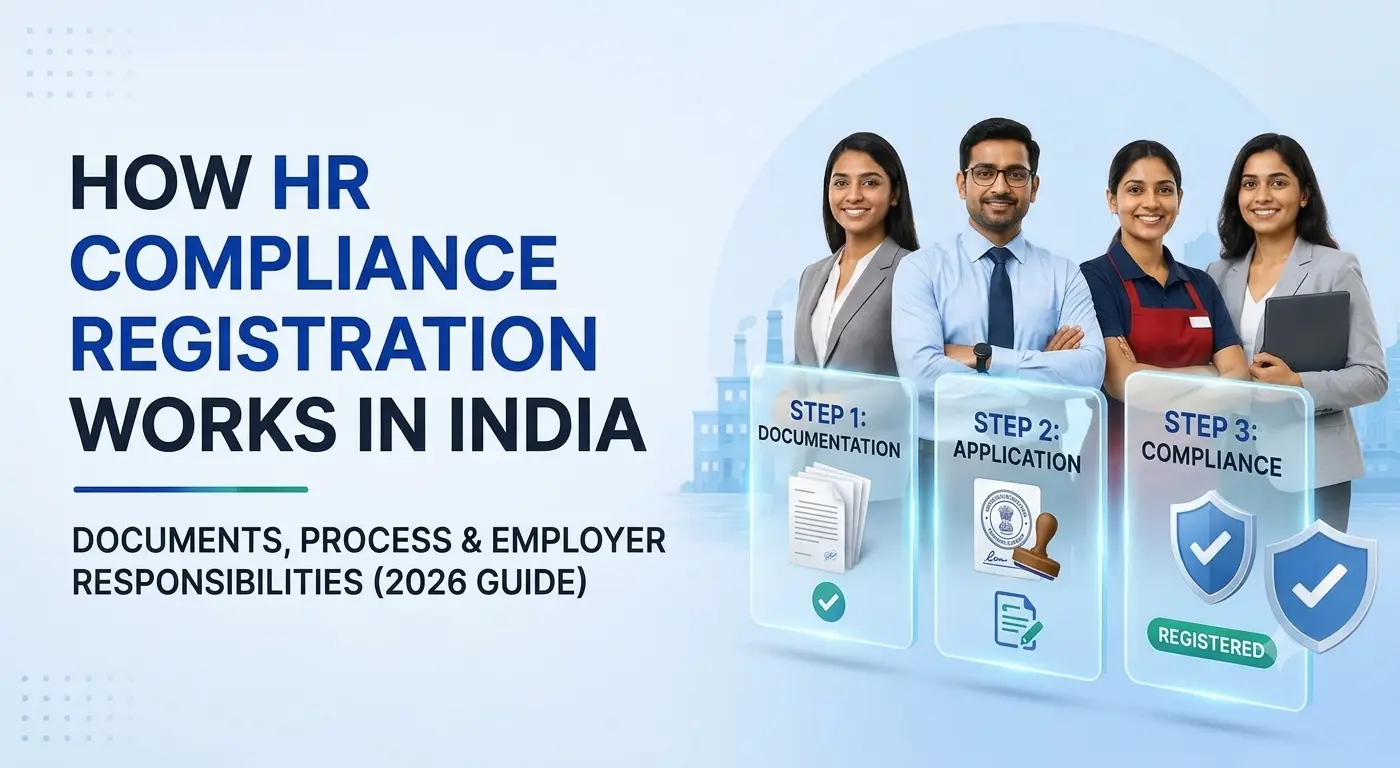
This guide covers the key documents, registration process and employer responsibilities to help businesses maintain HR compliance in 2026.
Important: Not universally mandatory; verify applicability against current law, rules, exemptions, and location.
Which HR Compliance Registrations Should Employers Assess?
The following table helps HR teams identify registrations for further verification. It does not establish that every registration applies to every organisation.
| Registration | Purpose | What to Verify |
| EPF / EPFO | Provident fund | Coverage, employee strength |
| ESIC | Employee insurance | Coverage, location, wage eligibility |
| Shops and Establishments | Shop/commercial regulation | State or UT law |
| Factory registration | Factory licensing | Classification, workforce |
| Contract labour | Contractor compliance | Thresholds, exemptions |
| Professional Tax | State tax | State applicability |
| Labour Welfare Fund | Welfare contributions | State law |
[Sources: EPFO | ESIC | Shram Suvidha | Labour Codes. (Professional Tax and Labour Welfare Fund: see state portals.)]
Documents Required for HR Compliance Registration
The document list depends on the registration, business constitution, location, and requirements of the relevant authority. The following are common preparation categories, not a universal mandatory list.
| Category | Commonly Required Documents | Note |
| Business and establishment | Incorporation certificate, PAN, partnership/LLP deed, address and premises proof, bank details, signatory details | Check portal list per registration |
| Employer and representative | Employer details, signatory contact, authorisation letter, digital signature | Representative must complete verification |
| Employee and workforce | Names, joining dates, designation, wages, UAN/insurance details, contractor data | Submit only necessary data; store securely |
[Reference: Shram Suvidha Registration Manuals.]
Step-by-Step Process for HR Compliance Registration in India
| Step | What to Do | Varies by Company Type / Industry |
| 1. Identify registrations | Review structure, activities, employee strength, locations, contractors. | Company, LLP, partnership, or proprietorship records differ; factories and contract labour need licences. |
| 2. Verify requirements | Check notifications and portals: Ministry of Labour, Shram Suvidha, EPFO, ESIC. | Multi-state businesses verify each state. |
| 3. Prepare documents | Checklist per registration; match name, PAN, address, authorisations, wage data. | New branches or address changes may need amendment. |
| 4. Submit online | Create an account, enter details, upload, authenticate. [Source: Shram Suvidha Portal.] | The process differs by registration. |
| 5. Track the Application | Save acknowledgement, respond to queries, maintain a tracker. | Consultant filings need employer oversight. |
| 6. Verification | Check certificate details; amend errors; store securely. | Format varies by authority. |
| 7. Compliance calendar | Record obligation, due date, owner, proof; verify deadlines officially. | Obligations vary by law, state, industry. |
EPF and ESIC Registration: Key Considerations
EPF Registration: Employers should check EPFO coverage requirements, prepare accurate establishment and employee details, and follow the official registration process. After registration, they must maintain relevant records and complete applicable contributions and filings.EPFO — For Employers.
ESIC Registration: Employers should verify establishment coverage, geographical applicability, employee eligibility, and wage requirements before registering. Refer to the ESIC website and Shram Suvidha Registration Manuals for official guidance.
Important: Establishment coverage and individual employee eligibility are separate requirements. HR teams should verify both under the applicable rules.
What Should Employers Review Under India’s Labour Framework in 2026?
India’s four Labour Codes were announced as effective from 21 November 2025. Employers should review the applicable rules and official notifications to ensure their registrations and compliance processes meet current requirements. [Source: PIB — 21 November 2025]
Employers should:
- Verify applicable rules and notifications.
- Check whether existing registrations need updates.
- Confirm registration requirements for new establishments and locations.
- Update compliance checklists using official guidance.
Important: Registration requirements vary by establishment and applicable law. Always verify the latest instructions before applying. Ministry of Labour and Employment.
How Business Structure and Location Affect Registration
| Business situation | What HR should verify |
| Sole proprietorship | Proprietor and business details, premises evidence, and applicable registration conditions |
| Partnership or LLP | Partnership or LLP records, authorised representative, and establishment details |
| Private limited company | Incorporation details, PAN, authorised signatory, and relevant establishment information |
| Business operating in multiple states | Applicable state requirements and whether separate registrations or notifications are necessary |
| Factory or manufacturing unit | Applicable establishment definition, activities, workforce conditions, and licensing requirements |
| Business using contract workers | Principal employer and contractor responsibilities under the applicable law |
| New branch or changed business address | Whether an amendment, additional registration, fresh application, or notification is required |
These are assessment points, not automatic legal conclusions. Confirm the requirements for the specific entity, establishment, and location.
Who Is Responsible for HR Compliance Registration?
| Role | Responsibility |
| Employer / owner | Ensure obligations are met, provide accurate information, approve submissions. |
| HR team | Coordinate checklist, records, tracking, and calendar. |
| Finance and payroll | Validate wage, bank, and contribution data. |
| Consultant | Assist within agreed scope; employer retains statutory responsibility. |
Common Mistakes to Avoid
| Mistake | How to Avoid It |
| Applying without checking applicability | Assess law, thresholds, exemptions first. |
| One checklist for every state | Use location-specific checklists. |
| Inconsistent information | Validate name, address, PAN, employee data. |
| Assuming registration ends compliance | Track filings, payments, renewals. |
| No evidence maintained | Store acknowledgements and correspondence securely. |
| Oversharing sensitive data | Use official portals; limit access. |
HR Compliance Registration Checklist
| 1. Prepare | 2. Apply | 3. After Registration |
| ☐ Confirm entity details
☐ Identify central and state registrations ☐ Verify rules and deadlines ☐ Prepare and validate documents |
☐ Submit via official portal
☐ Save acknowledgement ☐ Respond to queries |
☐ Verify issued details
☐ Update tracker and calendar ☐ Assign ongoing filings ☐ Store records securely |
Conclusion: Make HR Compliance Registration a Structured Process
Identify applicable requirements, prepare accurate documents, and apply through official channels. Maintain a registration matrix per entity and location, assign owners, and review it when you hire, relocate, or face legal updates. Explore Emgage’s HR and compliance services or Emgage HRMS solutions.
Disclaimer: This blog is for General information only, not legal advice. Requirements may change; confirm with the relevant authority or a qualified professional.
