
HRMS vs. HR Outsourcing vs. Hiring an HR Manager: Which Is Best for Your Business
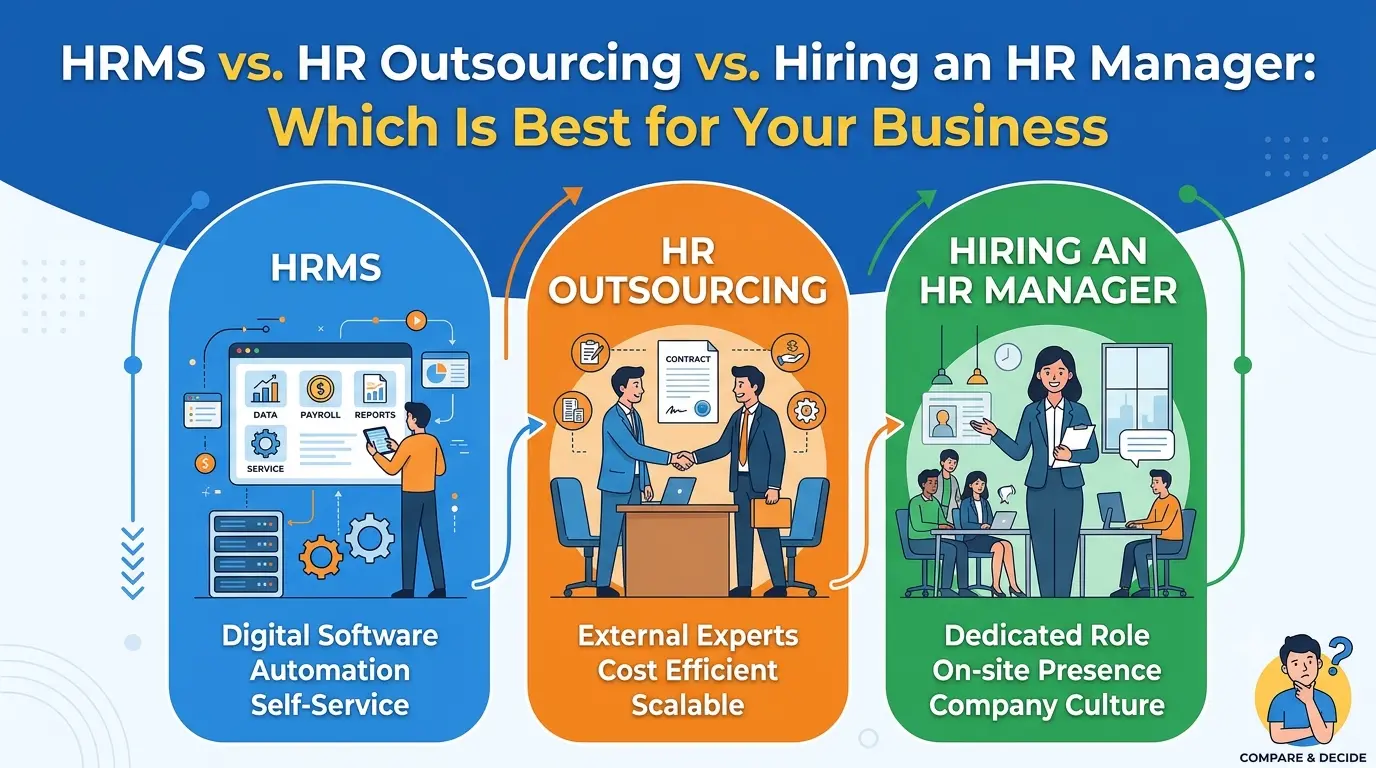
Once your team crosses 10–20 employees in India, HR stops being an admin side-task. Spreadsheets break down when ESI and EPF registrations kick in, professional tax must be deducted, and the new Labour Codes change wage definitions. You have three ways to handle this: HR software (HRMS), HR outsourcing, or a full-time HR Manager.
Quick answer: Under 25 employees, start with an HRMS. If you are growing fast across states without an HR person, outsource payroll and compliance on top of an HRMS. Past 50 employees, hire an HR Manager and equip them with an HRMS. An HRMS is part of every setup; the real question is who runs it.
When Does Your Business Need a HR Setup
Headcount triggers legal obligations, adding monthly calculations, deductions, and filings that must be accurate.
| Obligation | When it applies | What you have to do |
| ESI | 10+ employees (20 in some states) | Register, deduct, and deposit 4% of wages (3.25% employer + 0.75% employee) for staff earning up to ₹21,000/month (Source: Ministry of Labour, ESI Act). |
| EPF | 20+ employees under the Social Security Code | Register, deduct, and deposit monthly contributions; file returns (Source: Ministry of Labour). |
| Professional Tax | State-specific (e.g., Gujarat: ₹200/month above ₹12,000 salary) | Deduct monthly, pay to the state, register for PT (Source: State PT Acts). |
| TDS on salary | Any employee with taxable income | Compute, deduct monthly, file quarterly returns, issue Form 16. |
| Labour Codes | In force since 21 Nov 2025; state rules rolling out | Align salary structures to the new wage definition, update registers and policies (Source: DLA Piper, 2026). |
Note: ESI and EPF wage-ceiling hikes have been proposed but are not notified. Verify current thresholds and your state’s rules before acting.
1. HR Software (HRMS): The Tech Approach
An HRMS keeps all employee records in one place and automates repetitive administrative work.
What it handles:
- Payroll: Salary calculation with PF, ESI, PT, and TDS deductions built in.
- Attendance: Mobile or biometric punch-in, including geo-tagged punches for field staff.
- Leave: Employees apply via their phones, and balances update automatically.
- Records: Onboarding documents, contracts, and employee data in one secure system.
- Reports: Payslips, statutory reports, and headcount data generated on demand.
Where it falls short:
- Someone on your team still has to enter and verify the data.
- It cannot resolve conflicts between employees or handle grievances.
- It does not provide legal advice for non-standard situations.
| A 25-person design studio in Ahmedabad moves from Excel to Emgage HRMS. Employees apply for leave and mark attendance on the mobile app, and the system pulls this data directly into payroll. PF, ESI, and PT deductions calculate automatically, allowing the founder to simply approve payroll instead of building it manually. |
Best for: Teams of 10–40 where the founder or an office manager still handles HR but needs to eliminate spreadsheets.
- HR Outsourcing: The Outside Expert Approach
You pay an external firm to run payroll, statutory compliance, and occasionally wider HR tasks.
| Service Level | What is included | Typical Cost (Per Employee/Month) |
| Payroll Processing | Salary calculation, payslips | ₹150–₹400 |
| Managed Payroll + Compliance | Above, plus PF/ESI/PT/TDS filings and returns | Higher; varies by provider and states covered |
| Full HR Outsourcing | Payroll, compliance, recruitment support, employee queries | ₹800–₹2,500+ |
Why companies choose it:
- Lower compliance risk: The provider tracks changing rules and strict filing deadlines.
- Multi-state coverage: Highly useful when staff fall under different PT and state labour rules.
- No hiring needed: You gain HR expertise without adding a full-time salary to your overhead.
The trade-offs:
- Employees raise queries through a helpdesk ticket rather than speaking to a colleague in the office.
- Payroll correction turnaround times depend entirely on the provider’s SLA.
- You remain legally responsible as the employer, even if the outsourcing provider makes an error.
| A 40-person company with staff across Gujarat, Maharashtra, and Karnataka outsources compliance filings to a firm that processes payroll via Emgage. The company successfully handles three different PT slabs while maintaining direct access to their own employee data and reports. |
Best for: Growing companies of 20–60 employees, especially those expanding across state lines, that are not ready to build an in-house HR team.
3. The In-House HR Manager: The Human Approach
A full-time professional dedicated to managing your people day-to-day.
What they do:
- Hire and onboard the right talent for your business.
- Run performance reviews and train first-time managers.
- Handle workplace grievances, disciplinary issues, and employee exits.
- Ensure internal policies stay aligned with the 2025 Labour Codes and state rules.
The reality:
- This is the most expensive setup, with an HR Manager in India costing ₹6–25 lakh annually.
- Without an HRMS in place, this expensive hire will spend their time doing manual paperwork instead of developing people.
- Relying on one person creates a single point of failure for payroll if nothing is automated.
| A 75-person manufacturing unit near Ahmedabad hires an HR Manager. By utilizing Emgage’s attendance and payroll software to handle factory shift tracking and overtime, the HR Manager’s time is freed up to hire skilled operators and resolve shop-floor issues. |
Best for: Companies with 50+ employees where founders can no longer manage people operations directly.
The Hybrid Model: What Most Companies Actually Do
| Stage | Team Size | Recommended Setup |
| Early | 10–25 | HRMS + an external CA or consultant for statutory filings |
| Growth | 25–50 | HRMS + outsourced compliance, OR HRMS + a junior HR Executive |
| Scale | 50+ | HRMS + full-time HR Manager; outsource specialist work if needed |
Cost and Fit Comparison
Cost Comparison for a 30-Person Company:
- HRMS Only: ₹14,400–₹54,000 annually. You still pay for internal time to run payroll.
- Payroll Outsourcing: ₹54,000–₹1,44,000 annually. You still manage culture and hiring.
- Full HR Outsourcing: ₹2.9–₹9 lakh+ annually. You lack an on-site presence.
- HR Manager + HRMS: ₹6–25 lakh salary + software cost. The most complete, but highest cost.
Side-by-Side Setup Decision Matrix:
| Factor | HRMS | Outsourcing | HR Manager |
| Compliance accuracy | High, if data is entered correctly | High, handled by experts | Depends on the person and tools |
| Employee support | Self-service app | Ticket / helpdesk | In person |
| Builds culture | No | No | Yes |
Decision Checklist
- Is payroll still built in Excel? Lean towards an HRMS.
- Has a PF, ESI, or PT deadline been missed? Lean towards HRMS + outsourced compliance.
- Do you have employees in multiple states? Lean towards Outsourcing.
- Are you hiring 5+ people a month or over 50 employees? Lean towards an HR Manager.
Common Mistakes to Avoid
- Hiring an HR Manager before buying software: They will waste their first six months on spreadsheets.
- Assuming outsourcing removes legal liability: You are still the employer of record for PF, ESI, and wage compliance.
- Ignoring the 2025 Labour Codes: The new wage definitions can alter PF and gratuity calculations; check your structures immediately.
- Waiting for a penalty notice: Registration duties apply the exact day your headcount crosses statutory thresholds.
Frequently Asked Questions
- When should a company in India buy HR software?
Once you reach 10–20 employees. This is when ESI and EPF obligations begin, and manual payroll errors start costing the business money.
- If we hire an HR Manager, do we still need an HRMS?
Yes. The software handles calculations and records, while the HR Manager handles your people. Without software, an HR Manager just becomes a highly-paid payroll clerk.
- Does outsourcing make us legally safe?
It reduces the risk of administrative errors, but liability stays with you as the employer. Always check the provider’s track record and contractual indemnity terms.
- Is outsourcing HR safe for employee data?
It can be, provided you audit the provider’s data security practices. Ask exactly where data is stored and who has access to it before signing a contract.
- Do the new Labour Codes affect which option I choose?
The codes increase the compliance workload regarding wage structures and records. This makes utilizing an HRMS updated for the Codes vital, regardless of whether you manage it internally or outsource.
Conclusion and Next Steps
There is no single “right” HR setup, only the right one for your current scale. If your biggest pain point is manual payroll and missed deductions, start with an HRMS. If multi-state compliance is your primary risk, add outsourced payroll. Once active people management and culture become the priority, hire an HR Manager and give them the right software tools.
- Track your time: Log how many hours go into payroll and HR admin this month.
- Check your thresholds: Confirm where you stand on ESI, EPF, and PT for every state you operate in.
- Explore your options: Book a demo with Emgage to see how an automated HRMS handles payroll, attendance, and changing compliance codes for a team your size.
