
Can HRMS Software Create HR Policies or Only Store and Distribute Them?
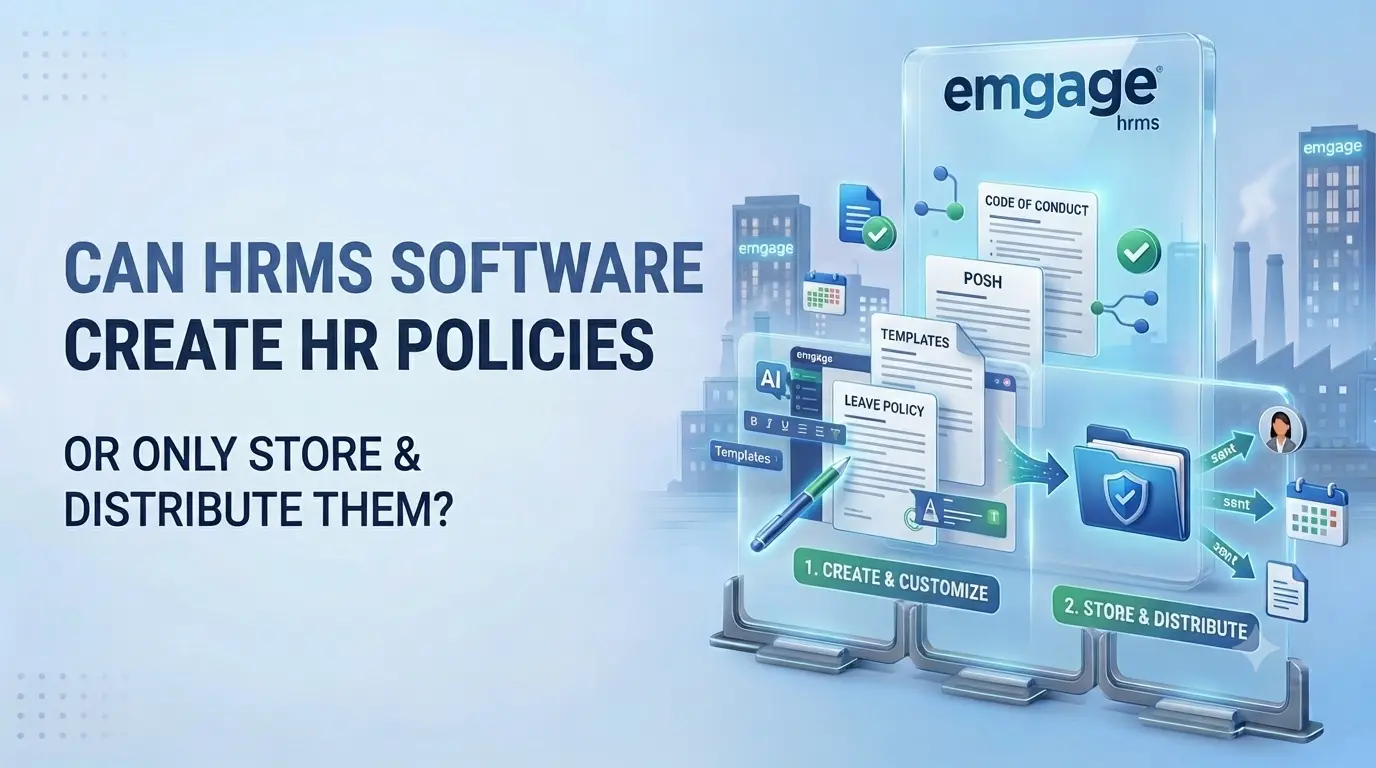
Every growing business needs well-defined HR policies. Whether it is leave management, attendance, employee conduct, work-from-home guidelines, or employee grievance management, these policies establish how an organisation manages its people. But who should create these policies? Can an HRMS software do it, or does a business need HR experts to design them?
The answer is that HRMS software primarily helps businesses automate and manage HR processes, while creating, reviewing, and designing HR policies requires specialised HR expertise. An HRMS can help implement policies through its leave, attendance, payroll, and employee management modules, but the actual policy design requires understanding business requirements and Indian labour laws.
This is where Emgage brings together two complementary solutions: HR Policy Design & Audit by HR experts and Emgage HRMS for automating everyday HR operations.
Quick Answer:
An HRMS is primarily designed to automate HR operations, not independently create company HR policies. At Emgage, HR policy creation is offered as a dedicated service where HR experts audit existing company policies, design new policies aligned with industry standards, and ensure alignment with applicable Indian labour laws. The team also supports the creation of SOPs, employee handbooks, and HR manuals, along with implementation and training. Once these policies are established, Emgage HRMS helps businesses automate their implementation through features such as leave and attendance management, payroll, employee documentation, and HR workflows.
How Can HRMS Software Help Create and Manage HR Policies?
Think of HR policy management as a process with multiple stages. Creating a document is only the beginning. A policy must be customised, approved, communicated, implemented, and periodically reviewed.
Here is how an HRMS-supported approach can help.
HR Policy Management: From Creation to Implementation
Identify
Understand the organisation's HR requirements.
Draft
Prepare policies using relevant templates and HR expertise.
Customise
Align policies with business requirements and applicable laws.
Approve
Get management and HR approval.
Publish
Make approved policies accessible to employees.
Implement
Connect policies with everyday HR processes.
Review
Update policies whenever business or legal requirements change.
1. Identify Which HR Policies Your Business Needs
Before creating policies, a business needs to identify which policies are actually required.
A 20-employee company may not need the same level of policy documentation as a 200-employee organisation. Similarly, a manufacturing company will have different HR requirements compared to an IT services company or a hospitality business.
For example:
- A manufacturing company may need detailed shift, overtime, safety, and attendance policies.
- An IT company may require work-from-home, information security, leave, and employee conduct policies.
- A hospitality business may need shift rotation, weekly off, grooming, and attendance policies.
An HRMS provides the employee and operational context that helps HR teams understand how the organisation works. However, identifying policy requirements requires an HR assessment.
This is where an HR policy audit becomes useful. It evaluates existing policies, identifies missing documentation, and highlights areas where the organisation needs better-defined rules.
2. Draft HR Policies Using Templates and HR Expertise
Once the requirements are identified, the next step is drafting the policies.
Businesses often start with downloaded Word documents or templates available online. While these can provide a starting point, using a generic template without customisation can create problems.
For example, a leave policy downloaded from the internet may mention 24 annual leaves. But your organisation may follow a different leave structure depending on its location, applicable laws, and internal requirements.
HRMS platforms may provide:
- Ready-to-use HR policy templates.
- Standard policy structures.
- Editable policy documents.
- Standard clauses for common HR requirements.
However, a template is not automatically a compliant policy.
The role of HR expertise: An HR professional should review the policy, understand the organisation’s requirements, and customise the document before it is approved.
For businesses without an internal HR team, an external HR consultant or virtual HR service can help prepare these documents.
3. Customise Policies According to Business Requirements
A policy should reflect how the business actually operates.
Consider a company’s leave policy. The organisation needs to define:
- How many leaves employees receive.
- Which types of leave are available.
- How leave is accrued.
- Whether leave can be carried forward.
- How leave encashment is handled.
- Who approves leave requests.
- What happens when an employee takes leave without approval.
These decisions should not be left to software.
An HRMS helps translate approved rules into operational configurations, wherever the relevant functionality is available.
For example, once the leave policy is finalised, the HR team can configure leave types, eligibility, accrual rules, approval workflows, and leave balances in the HRMS.
This ensures that the policy is not just a document sitting in a folder. It becomes part of the organisation’s daily HR operations.
4. Get Management Approval Before Publishing Policies
HR policies affect employees, managers, and business operations. Therefore, they should be reviewed and approved before implementation.
A typical approval process may involve:
- HR prepares the initial draft.
- Department heads review operational requirements.
- Finance reviews cost-related implications, wherever applicable.
- Management approves the final version.
- HR publishes the approved policy.
An HRMS can support policy approval and documentation workflows where these capabilities are available.
It is also important to maintain version control. If the organisation changes its leave policy in January, employees should not continue referring to an outdated version from the previous year.
5. Store and Distribute HR Policies Through HRMS
This is one of the most common uses of HRMS software.
Once policies are approved, businesses need a central place where employees can access them.
Managing policies through emails, WhatsApp groups, shared drives, and physical files often creates confusion. Employees may have different versions of the same document.
An HRMS can help centralise policy documents and make them accessible to authorised employees.
Depending on the platform’s capabilities, businesses can:
- Upload approved policy documents.
- Organise policies by category.
- Share policies with employees.
- Provide access to relevant employee groups.
- Maintain updated versions.
- Record employee acknowledgement, where supported.
For example, an organisation may have separate policies for corporate employees, factory workers, and field employees. Instead of sending every policy to everyone, access can be organised according to employee categories where the system supports it.
The objective is simple: Employees should know where to find the latest approved policy whenever they need it.
Still managing HR policies through emails and spreadsheets?
Centralise your HR processes with Emgage HRMS and make employee information and HR operations easier to manage. Schedule a free demo of Emgage HRMS
6. Implement HR Policies Through Everyday HRMS Workflows
This is where HRMS software creates the biggest operational value.
A policy is useful only when it is followed consistently.
For example, having an attendance policy is not enough if attendance is still tracked manually. Similarly, defining a leave approval process does not help if employees continue requesting leave through informal messages.
An HRMS connects approved HR rules with everyday employee activities.
Here are some examples:
| HR Policy | How HRMS Helps Implement It |
|---|---|
| Leave Policy | Leave types, balances, eligibility and approval workflows |
| Attendance Policy | Attendance tracking, late marks, regularisation and attendance rules |
| Work From Home Policy | Supporting attendance and approval processes, as configured |
| Overtime Policy | Recording overtime and applying approved rules where supported |
| Expense Policy | Expense submission, approval and reimbursement workflows |
| Payroll Policy | Salary structures, deductions and payroll configurations |
| Employee Separation Policy | Separation requests, approvals and exit workflows |
| Confirmation Policy | Employee confirmation tracking and related workflows |
The important distinction is that the HRMS does not decide what the policy should say. It helps ensure that approved rules are followed consistently through configured workflows.
7. Review and Update HR Policies Regularly
HR policies are not permanent documents.
Businesses grow, employee structures change, new branches open, and labour laws evolve. A policy that worked for a 25-employee organisation may not be suitable when the company grows to 200 employees.
For example, a company may initially have one attendance policy for everyone. As it expands into manufacturing and field operations, it may need different attendance and shift rules.
Similarly, changes in applicable labour laws may require organisations to review their existing policies.
An HRMS helps maintain updated employee processes and records. However, HR teams must periodically review the policy documents themselves and ensure that the system configurations match the latest approved version.
A quarterly or half-yearly policy review can help businesses identify outdated rules, operational gaps, and documentation requirements.
HR Policy Creation vs HR Policy Management: What Is the Difference?
Many businesses assume that buying an HRMS automatically solves their HR policy requirements. However, policy creation and policy management are two different activities.
| Parameter | HR Policy Creation | HR Policy Management Through HRMS |
|---|---|---|
| Primary Objective | Define rules and guidelines | Implement and manage approved rules |
| Main Responsibility | HR experts and management | HR team and HRMS |
| Business Understanding | Essential | Required for configuration |
| Legal Knowledge | Essential where applicable | Required for correct implementation |
| Documentation | Drafting and customisation | Storage and version management |
| Employee Communication | Explain policy changes | Distribute and provide access |
| Implementation | Define processes | Configure HR workflows |
| Review | Assess business and legal changes | Maintain updated operational settings |
The best approach is not choosing between HR policy creation and HRMS software. It is combining both.
An HR consultant or HR team brings the expertise needed to create the policies, while an HRMS provides the infrastructure to manage and implement them.
What HR Policies Should Every Growing Business Have?
The exact policies depend on the organisation’s size, industry, locations, and applicable legal requirements. However, growing businesses should consider reviewing the following categories.
| Policy Category | Important Policies |
|---|---|
| Employment Policies | Recruitment, onboarding, probation and confirmation |
| Attendance Policies | Working hours, shifts, weekly offs, attendance and overtime |
| Leave Policies | Annual leave, sick leave, casual leave, maternity and other applicable leave |
| Compensation Policies | Salary structure, incentives, bonuses and reimbursements |
| Workplace Policies | Code of conduct, anti-harassment, POSH and disciplinary action |
| Employee Welfare | Grievance redressal, employee benefits and insurance |
| Exit Policies | Resignation, notice period, full and final settlement and exit formalities |
| IT and Security | IT usage, data confidentiality, information security and device usage |
Not every organisation needs every policy in the same format. Some requirements are driven by applicable laws, while others are internal business decisions.
For Indian businesses, policies should also be reviewed against applicable central and state labour laws, establishment-specific requirements, and relevant notifications.
How Emgage Helps Businesses Connect HR Policies With HR Operations
Creating HR policies and implementing them are two sides of the same problem.
Many MSMEs have policies prepared in Word or PDF documents, but they struggle to implement them consistently. Employees may not know the rules, managers may follow different approval practices, and HR teams spend time resolving questions that could have been avoided with clearly defined processes.
Emgage addresses this through a combination of HR expertise and HR technology.
1. HR Policy Design and Audit
Businesses can get support in identifying policy gaps, reviewing existing documentation, and designing policies aligned with their business requirements.
2. HRMS for Operational Implementation
Emgage HRMS helps businesses manage everyday HR processes such as:
- Core employee records
- Leave and attendance management
- Payroll and compliance
- Employee confirmation and separation
- Expense and travel management
- Employee helpdesk
These modules help translate approved HR processes into structured workflows.
3. Virtual HR Support
Businesses without a dedicated HR department can also get access to HR support for managing employee lifecycle activities, HR processes, and policy-related requirements.
The idea is to ensure that businesses do not have to choose between hiring a full-fledged HR team and managing everything manually.
Need HR policies but don't have an internal HR team?
Get your HR policies reviewed and explore how Emgage HRMS can simplify their implementation.
HR Policy Management Checklist for Growing Businesses
Before considering your HR policy management process complete, check whether your organisation has covered these areas.
- Identified all policies required for the organisation.
- Reviewed existing policies for gaps and outdated information.
- Customised policies according to business requirements.
- Reviewed applicable legal and statutory requirements.
- Obtained management approval.
- Created a central repository for approved policies.
- Communicated policies to relevant employees.
- Established an employee acknowledgement process.
- Configured relevant HRMS workflows according to approved policies.
- Established a periodic policy review process.
Conclusion: HRMS Is More Than a Storage Platform for HR Policies
An HRMS should not be viewed only as a place to upload employee documents or distribute HR policies.
It can play a much bigger role in helping organisations implement HR rules, standardise processes, manage employee requests, and maintain consistency across locations and departments.
However, technology cannot replace the expertise required to understand business requirements, interpret applicable labour laws, and create appropriate HR policies.
The most effective approach is to combine professional HR policy design with an HRMS that makes those policies actionable.
For growing MSMEs, this means having access to both HR expertise and technology without necessarily building a large in-house HR department.
With Emgage, businesses can bring HR expertise and HR technology together, making HR policy management more structured, accessible, and practical.
If your organisation is still managing HR policies through scattered documents, spreadsheets, and emails, it may be time to rethink the approach.
Frequently Asked Questions
Can HRMS software automatically create HR policies?
Some HRMS platforms offer policy templates and AI-assisted drafting capabilities. However, the final policies should be reviewed and customised by HR professionals to ensure they reflect business requirements and applicable laws.
Can I create HR policies without an HR department?
Yes. Businesses can work with external HR consultants or virtual HR service providers to design their policies. An HRMS can then help manage and implement those policies.
What is the difference between HRMS and HR policy management software?
HR policy management software generally focuses on creating, storing, distributing, and tracking policy documents. An HRMS covers a wider range of HR operations, including employee records, attendance, leave, payroll, and other employee lifecycle processes. Some HRMS platforms also support policy documentation and acknowledgement.
Can an HRMS ensure employees follow company policies?
An HRMS can support consistent implementation through configured workflows, eligibility rules, approval processes, and employee records. However, it cannot guarantee employee compliance on its own. Management oversight, communication, and HR intervention remain important.
How often should HR policies be updated?
Businesses should review policies periodically, such as quarterly or half-yearly, and whenever there is a significant change in applicable laws, business operations, employee structures, or internal requirements.

Author
Dakshi Bhatt
Dakshi Bhatt is a Growth Marketer at Emgage, passionate about building brands and driving growth through SEO, content strategy, digital marketing, PR, and brand building. With an interest in organic growth, AI search optimization, and emerging digital trends, she enjoys blending creativity, strategy, and data to make brands more visible and impactful.