
How Can MSMEs Manage HR Remotely Without an In-House HR Department?
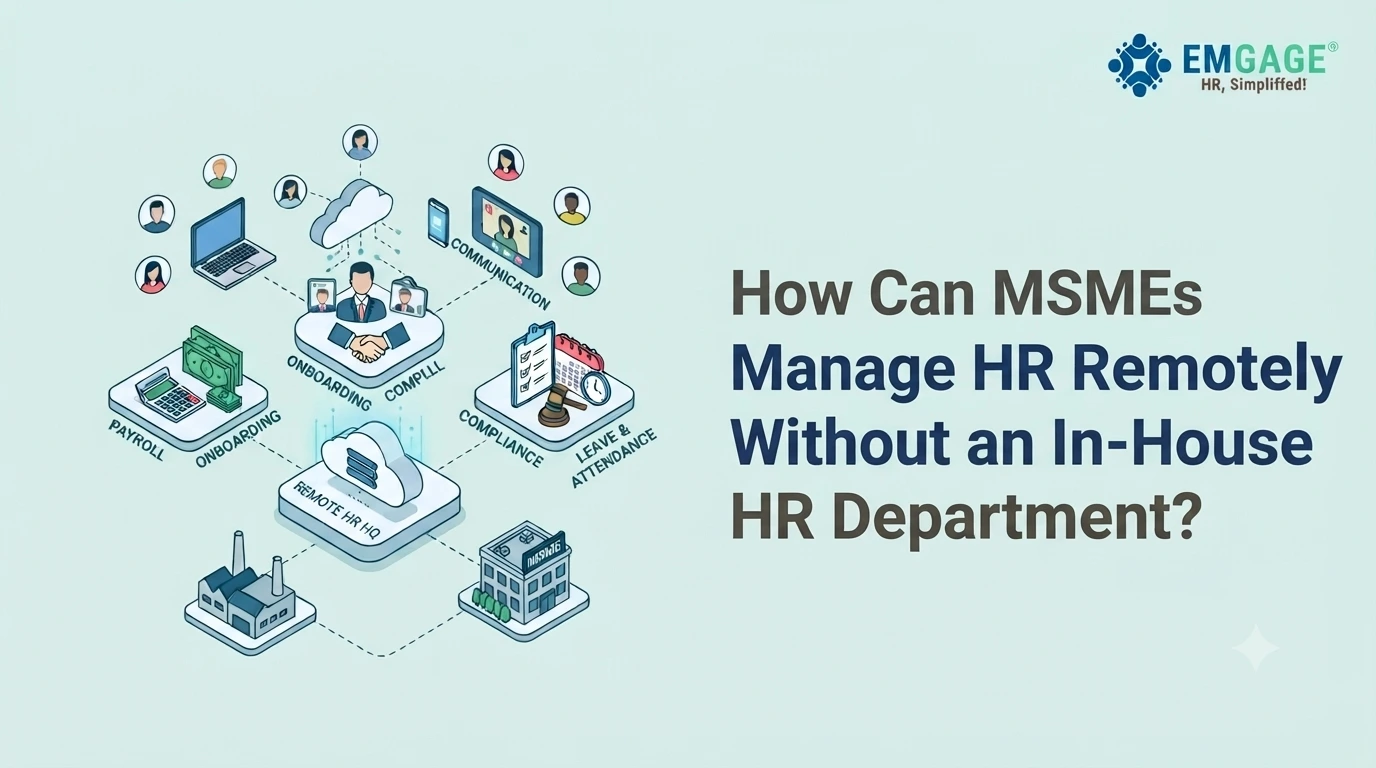
Managing employees involves much more than hiring people and processing salaries. As an MSME grows, businesses need to handle onboarding, employee documentation, payroll, leave and attendance, HR policies, employee queries, and statutory compliance. These responsibilities require consistent attention and professional HR expertise.
However, hiring a full-time in-house HR team is not always practical for small and growing businesses. It involves recruitment, salaries, training, and ongoing employee costs. At the same time, leaving HR responsibilities entirely to founders or administrative staff can make everyday operations difficult to manage.
This is where Remote HR becomes a practical alternative. By working with an external team of HR professionals, businesses can access day-to-day HR support without building an entire internal department.
For Indian MSMEs, a combination of professional HR expertise, clearly defined responsibilities, and digital HR tools can make employee management more structured and cost-effective.
Quick Answer
MSMEs can manage HR remotely by partnering with a professional HR service provider that handles employee lifecycle management, payroll, compliance coordination, HR policies, and employee queries. Instead of hiring multiple in-house HR professionals, businesses get access to a Virtual HR Team that manages these responsibilities with defined processes and digital tools.
Why Are HR Operations Becoming a Necessity for MSMEs?
HR operations are essential for every business that employs people, regardless of its size. From issuing appointment letters to processing salaries and managing employee exits, each activity needs proper documentation, coordination, and accountability.
For many Indian MSMEs, these responsibilities initially sit with the founder, finance team, or administrative staff. As business operations expand, managing them alongside core responsibilities becomes increasingly difficult.
Consider some everyday HR activities:
- Employee onboarding: Collecting documents, issuing appointment letters, and completing joining formalities.
- Payroll management: Coordinating salary calculations, deductions, payslips, and payroll records.
- Leave and attendance: Tracking employee attendance, leave balances, approvals, and irregularities.
- HR policies: Establishing workplace rules, leave policies, employee conduct guidelines, and procedures.
- Employee support: Responding to queries, issuing HR letters, and addressing workplace concerns.
- Compliance coordination: Tracking applicable PF, ESIC, TDS, and other statutory requirements.
These activities cannot be treated as occasional administrative tasks. They require regular attention and someone accountable for their completion.
An effective Remote HR arrangement allows MSMEs to access this expertise without making every HR responsibility an internal hiring requirement.
How Can Remote HR Services Outperform an In-House HR Team?
An in-house HR team offers direct access to employees and an understanding of internal operations. However, businesses may not always need multiple full-time HR professionals to manage their recurring requirements.
A professional Remote HR arrangement gives businesses access to a wider pool of HR expertise while reducing the cost and responsibility of maintaining an entire internal department.
Here is how the two approaches compare:
| Business Requirement | In-House HR Team | Remote HR / Virtual HR Team |
|---|---|---|
| HR expertise | Depends on the experience of hired professionals | Access to professionals across different HR functions |
| Hiring costs | Recruitment, salaries, training, and employee benefits | Service-based engagement without recruiting an entire team |
| Employee onboarding | Managed by internal HR employees | External HR professionals coordinate documentation and joining formalities |
| Payroll management | Requires internal payroll knowledge and coordination | HR specialists manage payroll activities and related records |
| Compliance support | Depends on internal expertise and available resources | Access to HR professionals for compliance coordination and support |
| Employee queries | Handled by the internal HR representative | Managed through an assigned HR contact and support channel |
| Employee continuity | HR responsibilities may be affected when an employee leaves | Shared expertise and backup support can reduce dependency on one person |
| Scalability | May require additional hiring as responsibilities increase | Service scope can be adjusted according to business requirements |
1. Access to Multiple HR Experts
An in-house HR manager may handle recruitment, payroll, employee relations, documentation, and compliance coordination.
However, one professional may not have the same depth of expertise across every HR function.
With Remote HR, businesses can access professionals specialising in different HR activities. This allows them to receive support across multiple functions without recruiting separate specialists.
2. Lower HR Operating Costs
Hiring an internal HR team involves more than monthly salaries. Businesses also need to consider recruitment, training, employee benefits, and replacement costs.
An external HR arrangement replaces multiple hiring requirements with a defined service fee.
This can make professional HR support more accessible to MSMEs that need regular HR operations but do not require a full-time department.
3. Continuity in HR Operations
When an internal HR manager resigns, businesses may need to recruit and train a replacement. During this transition, employee queries, payroll coordination, and documentation can be affected.
A structured Virtual HR Team arrangement can provide backup support and shared responsibility, reducing dependency on a single individual.
4. Faster Access to HR Support
Recruiting an experienced HR professional can take time. Once hired, the individual may also need to understand the company’s processes and systems.
An established HR service provider can offer a team that already works with HR processes and digital tools, helping businesses get started faster.
5. More Time for Business Priorities
Founders and business leaders should be able to focus on customers, revenue, operations, and growth.
Delegating recurring HR responsibilities to an external team reduces the time spent following up on employee documents, resolving routine queries, and coordinating administrative activities.
The result is a more organised HR function without requiring the business owner to manage every detail.
Is Remote HR Making a Difference for Other Businesses?
Hear how Beta Marine chose Emgage’s Virtual HR Team from day one and learn about its experience of working with an external HR partner.
Watch the Beta Marine Customer Testimonial
Want to explore a similar arrangement for your business?
How to Choose the Right Remote HR Solution for Your Business
Not every HR service provider offers the same level of involvement. Some focus primarily on payroll, while others provide broader employee lifecycle management and ongoing HR support.
Before selecting a provider, evaluate the following areas.
1. Understand the Scope of HR Services
Start by identifying the responsibilities you want to outsource.
Check whether the provider can support:
- Employee onboarding and documentation.
- Payroll processing and salary records.
- Leave and attendance management.
- HR policy development and implementation.
- Employee queries and HR letters.
- Employee confirmation and separation.
- Applicable statutory compliance coordination.
A clearly defined scope prevents confusion about which activities the provider will manage and which decisions remain with your business.
2. Check the Experience of the HR Team
Look beyond the provider’s service list. Understand the experience and expertise of the professionals who will manage your HR operations.
Ask whether you will receive an assigned point of contact, access to specialists, and backup support when your primary contact is unavailable.
3. Evaluate the Technology and Reporting
Remote HR should not mean limited visibility into employee information.
Check whether the provider offers a digital platform for employee records, attendance, leave, payroll information, and HR reports.
You should also understand how employee data is accessed, stored, and protected.
4. Compare Pricing and Service Inclusions
Compare the monthly service fee against the actual responsibilities covered.
Check employee limits, additional employee charges, implementation fees, software inclusions, and services that may cost extra.
The lowest quoted price may not always offer the right level of support.
5. Understand Accountability and Communication
Confirm who will handle employee queries, payroll coordination, approvals, and escalations.
A good provider should establish clear communication channels, reporting arrangements, and turnaround expectations.
Why Is Emgage the Right Fit for Your Remote HR Requirements?
Emgage brings together HR expertise and technology to help Indian MSMEs manage their employee lifecycle without building a full in-house HR department.
Through its Virtual HR Team, businesses get access to HR professionals who support everyday HR operations, from onboarding to employee exits.
Here is what the arrangement includes:
| Emgage Service | What Your Business Gets |
|---|---|
| Employee lifecycle management | Onboarding, documentation, appointment letters, probation reviews, confirmation, and exit coordination |
| Payroll management | Salary processing, payslips, deductions, TDS coordination, and Form 16 issuance |
| HR operations and compliance | Leave, attendance, payroll coordination, and PF and ESIC compliance support |
| Employee support | HR helpdesk, employee queries, policy guidance, and HR letters |
| Performance and reporting | Appraisal coordination, salary increment advisory, HR reports, and MIS generation |
| HR technology | Emgage HRMS Pro to support digital employee management and HR workflows |
Access 40+ HR Experts Through One HR Partner
Instead of depending on one internal HR employee, businesses can access Emgage’s team of 40+ HR experts across different HR functions.
You also get a shared HR manager who acts as the primary point of contact for your business and employees.
Get Started Without a Long Hiring Process
Emgage’s Virtual HR Team can get started within 48 hours, according to its service offering.
This allows businesses to begin organising their HR operations without going through the usual recruitment and onboarding process for an internal HR team.
Get HR Support at a More Accessible Cost
Compared with maintaining an in-house HR team or engaging higher-priced external HR arrangements, Emgage pricing is cost-conscious option for businesses looking to access multiple HR capabilities through one service provider.
| Comparison Parameter | Emgage Virtual HR Team | Typical Remote HR Service Arrangement |
|---|---|---|
| HR expertise | Access to 40+ HR experts | Depends on provider and assigned team |
| Dedicated contact | Shared HR manager as the primary contact | Varies by service provider |
| HRMS inclusion | Emgage HRMS Pro included in the listed package | Software inclusion varies |
| Employee lifecycle | Onboarding-to-exit support | Scope varies by package |
| Backup support | Shared team of HR professionals | Depends on team structure |
The key difference is the combination of HR expertise, employee lifecycle support, and HRMS technology under one arrangement.
Frequently Asked Questions
What is Remote HR, and how does it work?
Remote HR is a model in which a business works with external HR professionals who manage or coordinate its HR operations. These activities may include onboarding, payroll, employee documentation, HR policies, compliance coordination, and employee queries. Communication and records are managed through digital platforms and defined processes.
Is Remote HR suitable for small businesses in India?
Yes. Remote HR can be suitable for Indian startups and MSMEs that need professional HR support but do not require a full-time internal HR department. Businesses can outsource recurring HR responsibilities while retaining control over important employee and management decisions.
What is included in a Virtual HR Team?
A Virtual HR Team can support employee onboarding, documentation, payroll, leave and attendance, HR policies, employee queries, compliance coordination, and exit formalities. The exact services depend on the provider and selected package.
Is Remote HR more affordable than hiring an in-house HR team?
It can be. Businesses avoid several costs associated with recruiting, training, and maintaining an internal HR department. However, the actual savings depend on the service scope, workforce requirements, and the cost of the internal team being replaced.
Can an external HR team manage employee queries and payroll?
Yes. Depending on the service agreement, an external HR team can manage routine employee queries, issue HR letters, coordinate payroll processing, and maintain relevant employee records. Businesses should establish clear approval responsibilities and escalation procedures before outsourcing these activities.

Author
Dakshi Bhatt
Dakshi Bhatt is a Growth Marketer at Emgage who believes in the power of good ideas and thoughtful marketing to build memorable brands. Working across SEO, content, digital marketing, PR, and branding, she enjoys exploring new trends, finding creative ways to tell brand stories, and making businesses stand out in an ever-evolving digital world. With a love for words, she enjoys turning ideas into narratives that inform, engage, and leave an impression.