
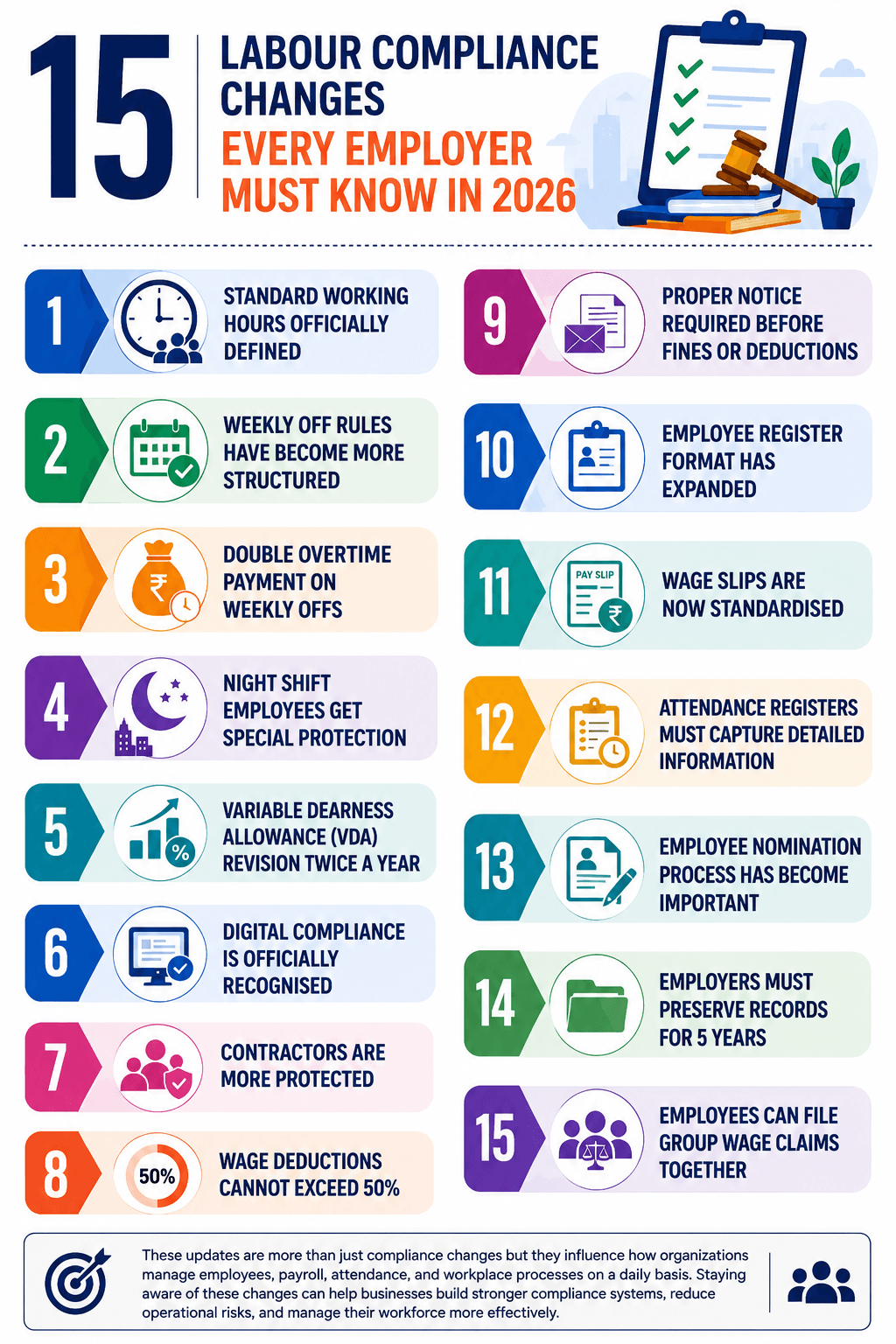
15 Labour Compliance Changes Every Employer Must Know in 2026

When working with founders, HR teams, and growing businesses, I realized that keeping up with changing labour law requirements can often become challenging, especially when companies are already managing payroll, attendance, employee records, and day-to-day operations together. With the introduction of the Wage Code Rules 2026, several important compliance changes now directly impact how organizations manage wages, overtime, working hours, documentation, and employee records.
To make these updates easier to understand, I have simplified some of the most important compliance changes that every employer and HR professional should be aware of. This blog focuses on practical updates that can help organizations strengthen compliance processes, avoid penalties, and manage their workforce more efficiently.
1. Standard Working Hours Officially Defined
The new rules clearly define standard working hours as:
- 8 hours per day
- Maximum 48 hours per week
This brings more clarity in attendance tracking, overtime calculation, and payroll processing. Employers must now ensure that HR policies, attendance systems, and employee shift structures are aligned with these limits.
2. Weekly Off Rules Have Become More Structured
Employees must now be provided with:
- One weekly rest day
- Normally Sunday as the weekly off
For establishments operating for less than six working days, Saturday and Sunday may both be considered weekly offs depending on company policy.
If an employee works on a weekly off day, the employer must provide a substituted rest day. Also, employees cannot be made to work continuously for more than 10 days without a weekly rest day.
3. Double Overtime Payment on Weekly Offs
If employees are required to work on their designated weekly off:
- Overtime wages must be paid
- Payment cannot be less than twice the normal wage rate
This is a very important payroll compliance requirement. Companies must maintain proper overtime records and attendance tracking to avoid disputes or penalties during inspections.
4. Night Shift Employees Get Special Protection
The Wage Code Rules now specifically define how workdays and weekly offs should be calculated for employees working beyond midnight.
This change mainly affects:
- Manufacturing companies
- BPOs and call centres
- IT and ITES companies
- Healthcare institutions
- Security services
Attendance and payroll systems should now properly account for night shifts and cross-day working hours.
5. Variable Dearness Allowance (VDA) Revision Twice a Year
The Rules now require Variable Dearness Allowance (VDA) to be revised:
- Before 1st April
- Before 1st October every year
The revision will depend on Consumer Price Index (CPI) data issued by the Labour Bureau. Companies paying minimum wages must regularly monitor these revisions and update salary structures accordingly.
6. Digital Compliance Is Officially Recognised
The new Rules officially recognise:
- Electronic notices
- Digital wage slips
- Online registers
- Electronic communication
- Digital attendance systems
This is a major shift towards digital HR compliance and supports organizations using HRMS, payroll software, and online employee management systems.
7. Contractors Are More Protected
If employees are hired through contractors:
- The principal employer still remains responsible for wage-related compliance
- In some situations, the principal employer may also become liable for minimum bonus payments if the contractor defaults
This increases compliance responsibility for companies engaging contract labour and third-party staffing agencies.
8. Wage Deductions Cannot Exceed 50%
The Rules now clearly state that total deductions from employee wages cannot exceed:
- 50% of wages in a month
This includes:
- Loans
- Advances
- Damages
- Fines
- Other recoveries
If deductions exceed the limit, the remaining amount must be carried forward to future months.
9. Proper Notice Required Before Fines or Deductions
Before imposing:
- Fines
- Absenteeism deductions
- Damage recovery deductions
The employer must:
- Issue written or electronic notice
- Provide 7 days for employee response
- Communicate the final decision properly
This strengthens employee protection and ensures fair disciplinary procedures.
10. Employee Register Format Has Expanded
The new Employee Register format now requires additional details such as:
- UAN
- ESIC IP Number
- Aadhaar Number
- Bank details
- Family details
- Nominee details
- Employment category
- Skill category
- Photo and identification marks
This means companies must maintain more detailed employee records than before.
11. Wage Slips Are Now Standardised
Every employer must issue wage slips in the prescribed format including:
- Basic salary
- Dearness Allowance (DA)
- Allowances
- Overtime wages
- PF deductions
- ESI deductions
- Net salary payable
This improves payroll transparency and helps employees clearly understand their salary breakup.
12. Attendance Registers Must Capture Detailed Information
The Attendance Register-cum-Muster Roll must now include:
- Daily in and out timing
- Shift details
- Overtime hours
- Department details
- Work location
- Outside assignment information
Improper attendance management can now directly lead to compliance issues during inspections or audits.
13. Employee Nomination Process Has Become Important
Employees must now submit nomination forms for:
- Pending wages
- Dues payable after death
In case of marriage or family changes, fresh nominations may also become necessary. Proper nomination records help in smoother settlement of employee dues.
14. Employers Must Preserve Records for 5 Years
All wage and attendance-related records must now be preserved for:
- Minimum 5 years from the last entry date
These records become extremely important during:
- Labour inspections
- Payroll audits
- Employee disputes
- Legal investigations
Organizations should ensure both physical and digital records are properly maintained.
15. Employees Can File Group Wage Claims Together
The Rules now allow:
- Group wage claims
- Complaints through trade unions
- Electronic filing of claims
This makes wage dispute resolution more organised and accessible for employees.
These updates are more than just compliance changes but they influence how organizations manage employees, payroll, attendance, and workplace processes on a daily basis. Staying aware of these changes can help businesses build stronger compliance systems, reduce operational risks, and manage their workforce more effectively.
