
Mastering the New Labour Codes 2025: A Practical Guide for Indian Businesses
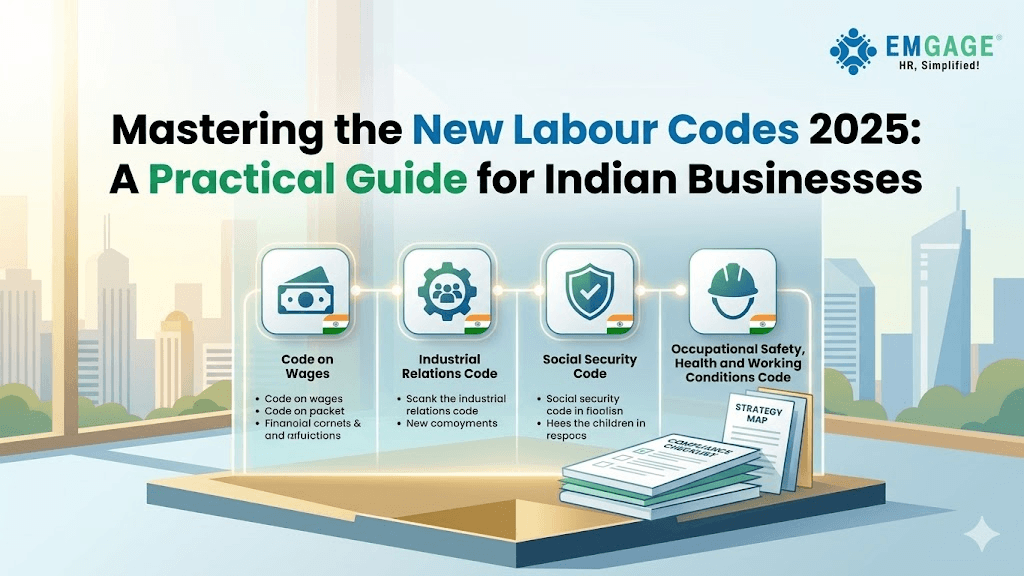
Indian businesses encounter a fundamental shift in labor laws! On November 21, 2025, the government officially replaced 29 fragmented laws with four new labor codes. This is the biggest regulatory transformation in decades. For growing businesses in 2026, it is absolutely essential to put an end to informal hiring and start a more streamlined and transparent relationship with their employees. At Emgage, we act as your compliance shield and ensure this regulatory shift shouldn’t restrict your growth. Here is a detailed view of shifting regulations that every employee and employer should need to know.
What are the 4 New Labor Codes?
The Indian government officially announced the consolidation of 29 outdated regulations into four clear categories:
- Code on Wages (2019) – This code derives a single, uniform definition of “wages” across India. It ensures maintaining consistency in minimum wage calculations and salary components. Under this regulation, employees benefit from higher retirement savings (PF) and gratuity.
- Code on Social Security (2020)—This is the most crucial update, expanding the safety net of employees across traditional office spaces. It mandates coverage like PF and medical insurance for gig workers and platform workers in all 740+ districts in India.
- Industrial Relations Code (2020) – This regulation modernizes the system behind running a business and managing a workforce. Businesses can hire employees on a contract basis with the same benefits as permanent staff to avoid conflicts between management and workers.
- Occupational Safety, Health, and Working Conditions Code (2020) – Setting standards for the workplace and workforce. To ensure the physical and mental well-being of employees, it focuses closely on safety protocols, including free health checkups, transport facilities, etc.
Why Were the Labor Codes Implemented?
The replaced laws were created decades ago, before the internet and smartphones. The new codes aim to:
- Easy Business Handling: The labor code replaces managing a bundle of paperwork with a unified digital portal. It allows businesses to file registrations and returns in one place.
- Modernized Work Culture: This law supports creating digital-first work environments like remote work and the gig economy. It incorporates the nuances of today’s work culture and benefits both the employees and employers.
- Universal Protection: For the first time, safety regulations extended beyond the workplace. From top-tier executives to gig workers, every employee gains legal identity and social security benefits.
12 Most Critical Changes You Need to Action Now
- The 50% Basic Pay Rule – Basic salary + DA must be at least 50% of their total CTC. It may slightly reduce an employee’s take-home pay but significantly increase their long-term savings through a higher bonus, gratuity, and PF.
- Universal Appointment Letters – The new regulations eliminate the gap in informal hiring. It can be a corporate office, factory, or a retail shop; every employee should receive a formal appointment letter to earn professional trust and protect your business from legal disputes.
- Pan-India ESIC – Previously, ESIC benefits were applicable only to specific areas, exceptional to remote and rural workers. The revised labor codes expand the healthcare benefits to the entire country.
- Security for Gig and Platform Workers – This code official recognizes the shadow workforce like cab drivers, freelance platform workers, cab drivers, etc. The Indian government allocates social security funds like ESI, PF, and disability funds to bring stability to the economy.
- Gratuity for Fixed-Term Employees – Employee benefits have now expanded beyond permanent employees. Fixed-term or contractual employees are now eligible for gratuity benefits after 1 year of service.
- The 48-Hour Work Week – To prioritize the physical and mental well-being of workers, the new code limits the weekly working hours to 48 hours. The daily shift can vary between 8 and 12 hours to ensure a better work-life balance.
- Double Overtime Pay – If employees work beyond the determined daily or weekly limit, employers are required to pay double the hourly rate. It ensures their excessive efforts are fairly compensated.
- Mandatory Annual Health Checkups – To promote a healthier work environment, employers are mandated to arrange a free annual checkup for employees aged 40 years and above.
- Mandatory Safety Committees – The entities or organizations with 500 or more workers should form a joint safety committee. It must have both worker and management representatives to manage safety standards, identify workplace hazards, and prevent industrial accidents.
- Safe Nights Shifts for Women – Women are working on night shifts (7 pm to 6 am) across all sectors. Hence, to ensure their safety protocols, employers must arrange for transport and adequate safety measures at the workplace.
- National Floor Wage – To eliminate the confusions caused by different minimum wages between different states, the central government has announced a National Floor wage. No state government can change this baseline, which is applicable to all workers in every state.
- Timely Salary Disbursement – The new code emphasizes that the salary should be disbursed by the 7th date of the following month. It allows employees to manage their financial commitments on time.
How These Changes Impact Employers and Employees
| Feature | Impact on Employers | Impact of Employees |
|---|---|---|
| Take-Home Pay | Companies need to restructure salary regulations to stay compliant with new codes. | May see a slight decrease in take-home pay, but will receive long-term benefits through higher PF deductions. |
| Retirement benefits | Employers encounter long-term financial liability per employee. | Employees can receive higher gratuity and PF benefits due to the 50% basic rule. |
| Healthcare | Need to establish broader compliance even for small teams. | Access to ESIC regardless of job type across all states. |
What Businesses Need to Do Right Now?
Businesses must adopt the New Labor Codes – not just to avoid penalties but to protect their brand reputation and ensure long-term financial security for employees. The very first thing is conducting an HR policies and compliance audit to identify which are not complying with the new regulations.
Most commonly, businesses have gaps in their leave policies, salary structures, and appointment letters that lead to serious legal consequences under the 2025 mandates. To handle the heavy lifting, companies should take the help of professional HR service providers, such as Emgage to audit and find compliance loopholes without burning a hole in your pocket. Step in to secure your business and get your free HR audit today!
